











































-
VRS

-
CaptionCall
-
Enterprise
-
Provider
-
Resources
-
Company


Sorenson Uses Cookies
Cookies are small text files websites send to your browser to remember information about your visit. They make our site work properly and help with security. When you allow cookies, you will have the best experience on our site — you can use tools such as chatbot for support and access other relevant products and services.

Interpreter vs. Translator: What’s the Difference and Which Do You Need?
September 16, 2026

An interpreter converts spoken or signed language in real time. A translator converts written or recorded content, usually after it is created. Although the terms are often used interchangeably, they describe different services.
Knowing the difference helps you choose the right language support for a meeting, event, training session, or document. A third option, AI live translation, can also support multilingual communication in many everyday business and event settings.
What is an interpreter?
Interpreters convert spoken or signed communication from one language to another in real time. They may work in person, over the phone, or via video.
Two main types of interpreting are:
- Simultaneous interpreting: The interpreter speaks or signs while the presenter is communicating, usually with a short delay.
- Consecutive interpreting: The speaker pauses at intervals so the interpreter can convey the message.
Professional interpreting requires language skills, cultural knowledge, contextual judgment, and specialized training. Fluency alone is not enough. Interpreters must accurately interpret meaning and intent while navigating cultural nuances and specialized terminology.
What is a translator?
Translators convert written or recorded content from a source language into a target language. This can include documents, transcripts, subtitles, and written content associated with audio, video, or multimedia.
Depending on the content and the required accuracy, translation may involve a qualified human translator, an automated translation tool, or both.
Where does AI live translation fit?
AI live translation is a newer category. Some people refer to this technology as interpretation or AI speech translation, but it is not interpreting. Live translation services process spoken language and deliver real-time captions or translated audio to participants’ own devices.
Human interpreters are generally the better fit when communication requires a high degree of accuracy, contextual judgment, or sensitivity, including many legal and medical interactions.
For routine or large-scale business communication, scheduling, interpreter availability, and service costs can make human interpretation difficult to scale. Translation services can expand access in meetings, training sessions, town halls, and multilingual events where broad comprehension and scale are the priorities.
AI live translation typically combines several technologies. Speech recognition converts the speaker’s voice into text. Language-processing and machine-translation systems then translate the text in real time. The platform delivers translated captions, synthesized audio, or both to participants.
Performance depends on factors like audio quality, language availability, accents, background noise, and specialized terminology. Test any platform using conditions similar to your real-world meetings.
When to use an interpreter, translator, or AI live translation
The best option depends on your audience, communication format, stakes, and accuracy requirements.
| Situation | Best starting point | Why |
|---|---|---|
| Written documents or follow-up materials | Human or automated translation | The source content is written or recorded rather than live |
| Routine multilingual meetings or training | AI live translation | Supports multiple spoken languages at scale |
| High-stakes or sensitive spoken communication | Qualified human interpreter | Helps preserve nuance and reduce misunderstandings |
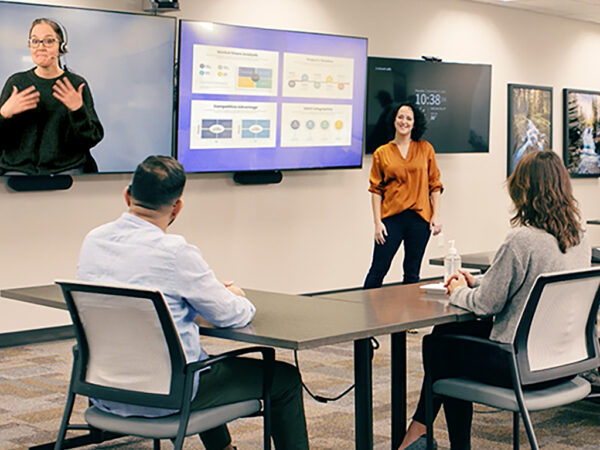
| Live communication with participants who use ASL | Qualified ASL interpreter | Provides direct access in a visual language |
| Large event with multilingual and Deaf audiences | Combined support | May require AI live translation, captions, and qualified interpreters. |
For a more detailed decision framework, learn when to use AI vs. human interpreters.
What to look for when evaluating live translation services
When comparing live translation services, look for:
- Support for the languages your participants use
- No-download participant access
- Two-way communication for multilingual conversations
- Live captions and transcripts
- Compatibility with existing platforms
- Options that support both multilingual audiences and Deaf or hard of hearing participants, including captions and access to human interpreting when needed
Sorenson Forum is one example of a platform that combines live translation and captioning for business meetings and events.
A note on ASL and Deaf communication
ASL is a distinct visual language, not a signed version of English. Many Deaf people in the United States use ASL as their primary language. AI captions do not replace a human ASL interpreter.
If a participant uses ASL, a qualified ASL interpreter may be the appropriate form of language access. Ask participants about their communication preferences.
AI live translation can extend spoken-language access to multilingual participants across a meeting or event.
Sorenson offers both qualified ASL interpreting and AI live translation, allowing organizations to build support around different audience needs.
Find the right option for your next meeting
Not sure which option fits your next meeting or event? Try Sorenson Forum with a free trial or talk with one of our accessibility experts.
FAQs
Q: What's the difference between an interpreter and a translator?
A: An interpreter conveys spoken or signed language in real time. A translator converts written text or recorded content, usually after it is created.
If you need real-time language access in a meeting, event, or training, use a human interpreter or an AI live translation service rather than document translation.
Q: Is AI live translation the same as an interpreter?
A: No. AI live translation delivers real-time captions and translated audio to participants' devices as a speaker talks. It serves a similar function to simultaneous interpretation for multilingual audiences, but it is not a human interpreter. It works well for meetings, events, and training where broad comprehension is the goal.
It should not replace a qualified human interpreter in high-stakes legal or medical communication or when a participant needs ASL interpretation.
Q: When should you use a human interpreter vs AI live translation?
A: Choose a qualified human interpreter when the interaction is high-stakes, sensitive, legally significant, or dependent on cultural and contextual judgment, and any communication with Deaf or hard-of-hearing participants who use ASL.
Use AI live translation for meetings, training, conferences, and events where you need to support multiple languages simultaneously at scale. See our full breakdown in AI Translation vs. Human Interpreters: When to Use Each.
Q: Can AI replace a human ASL interpreter?
A: No. Current AI tools do not replace qualified ASL interpreters. Sorenson is also developing AI Sign Language Translation for low-context situations. It is not presented as a substitute for professional interpreting in complex or high-stakes communication. Explore an AI Sign Language Translation pilot.
Q: What is an interpretation app?
A: An interpretation app (or interpreting app) is a software platform that delivers live language interpretation or AI translation directly to participants' devices. Participants can access the service on a phone or laptop through a link or QR code, without separate listening equipment. Sorenson Forum is one example — it delivers real-time AI translation and captions in 25+ languages to each participant's own device.
 Malala Alonso