




































-
VRS

-
CaptionCall
-
Enterprise
-
Provider
-
Resources
-
Company


Sorenson Uses Cookies
Cookies are small text files websites send to your browser to remember information about your visit. They make our site work properly and help with security. When you allow cookies, you will have the best experience on our site — you can use tools such as chatbot for support and access other relevant products and services.

AI Translation vs Human Interpreters: When to Use Each
July 9, 2026
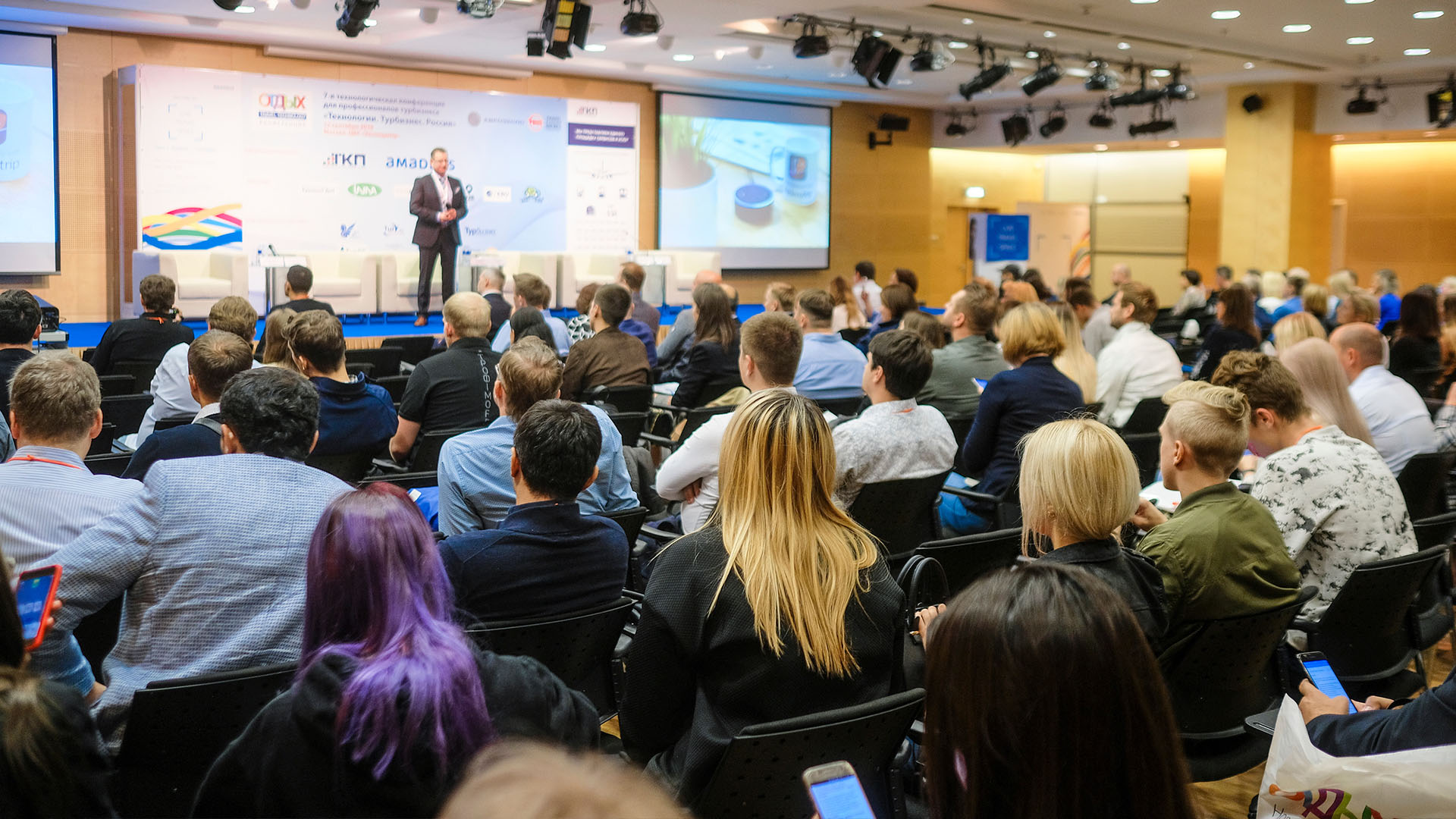
AI-powered live translation and human interpreters both work. The challenge is that both are useful in different situations. If you’re an HR manager, event coordinator, or L&D lead trying to figure out which one fits your next meeting, training, or event, here’s a practical framework for deciding.
What AI-powered live translation actually does
Real-time AI translation takes a speaker’s words and delivers them as captions, text, or translated audio to each participant’s device — in their chosen language — as the session happens. Participants can also receive transcriptions after the session.
Attendees join via a link or QR code. No special hardware, no advance scheduling, no dedicated interpreter per language.
This works well when the goal is broad comprehension. A multilingual all-hands. An onboarding session for 50 people who speak five different languages. A conference where attendees need to follow a keynote. Custom glossaries can be configured for industry-specific terms, which helps in technical training environments.
Where it breaks down: any situation where the precision of every word matters. AI live translation is not 100% accurate, and it does not catch tone, hesitation, or cultural subtext the way a person does.
What a human interpreter brings
Human interpreters, on the other hand, pick up on voice fluctuations that signal emotion, navigate cultural context, adapt to accents or highly technical language, and, importantly, ask for clarification when something’s unclear.
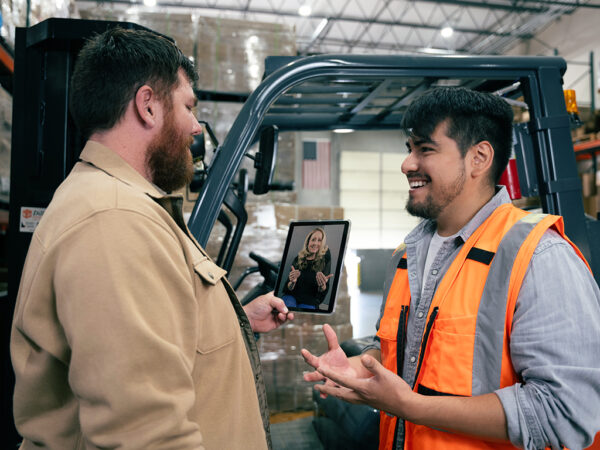
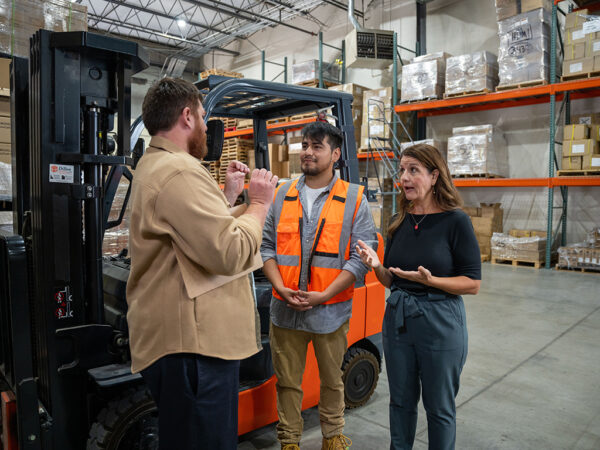
This is true for any spoken language pair, but it’s especially important for Deaf and hard-of-hearing participants who use American Sign Language. ASL is its own language with its own grammar and syntax. It is not a transliteration of English. Communicating with a Deaf participant who uses ASL requires a qualified human ASL interpreter — that is not a situation where captions or AI are currently an adequate substitute.
Use this framework to decide
This isn’t exhaustive, but it covers the most common enterprise scenarios of when to use live interpretation vs AI translation.
| Scenario | Deaf/Hard-of-Hearing attendees | Multilingual attendees |
|---|---|---|
| Company all-hands meeting | ASL interpreter + AI captions | AI live translation and captions |
| Employee training or onboarding | ASL interpreter + AI captions | AI live translation and captions |
| Recurring internal meetings | ASL interpreter + AI captions | AI live translation and captions |
| Conference or event | ASL interpreter + AI captions | AI live translation and captions |
| Academic conference with specialized vocabulary | ASL interpreter + AI captions | Either — depends on precision required |
| Legal proceeding or deposition | Legal-trained and certified ASL interpreter + legal notes | Human interpreter |
| Medical consultation or sensitive clinical interaction | ASL interpreter + AI captions (provides transcription to doctor and patient) | Human interpreter |
| High-stakes negotiation or board-level discussion | ASL interpreter | Human interpreter |
When you might need both
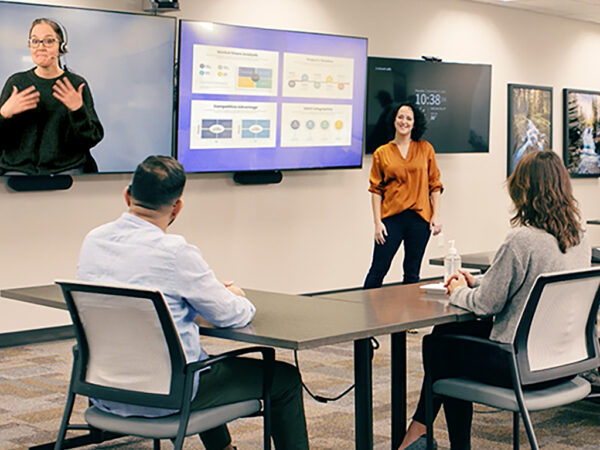
A company all-hands or employee training might have employees who speak multiple languages and employees who are Deaf or hard-of-hearing. An event could have Deaf or hard-of-hearing participants. AI live translation handles the multilingual and non-signing side. An ASL interpreter handles communication with Deaf participants who use ASL.
Is AI ready for sign language translation?
Not yet for most situations, but it's where Sorenson is actively building. Our AI Sign Language Translation development focuses on everyday interactions where a human interpreter isn't available: short service moments, training content, routine exchanges.
Two proof-of-concept tracks are in progress. One translates spoken and video training content into ASL for LMS platforms; the other translates ASL to English in real time for in-person service interactions like kiosks and counters. Both are being developed with Deaf professionals, community input, and human quality review, and are designed to expand access in low-context situations.
Figure out what you need
Now that you know when different kinds of translation and interpreting can be used, the next step is to put them into practice. If you want to test to see how AI translation and captions work for your scenario, Sorenson offers a free trial.
FAQ
Q: Is AI translation accurate enough for enterprise meetings?
A: For most enterprise meetings, training sessions, and events where broad comprehension is the goal, yes. AI live translation handles general business language well, and custom glossaries can be configured for industry-specific terminology. If you are providing accessibility services to a Deaf/hard of hearing person, ask them if they would like captions in addition to an ASL interpreter.
Q: When should you use a human interpreter instead of AI?
A: For spoken language interpretation, use a human interpreter when the stakes of a mistranslation are high, such as legal proceedings, medical consultations, nuanced negotiations, or situations requiring deep cultural context.
For Deaf or hard-of-hearing participants who communicate in American Sign Language, human ASL interpreters are essential. AI Sign Language Translation (AST) is still in development and pilot testing. It’s built for situations where live interpreters aren’t always practical, such as short, routine interactions and recorded learning content.
Q: Can AI translation and human interpreters be used in the same session?
A: Yes. Organizations can run AI live translation (via a platform like Sorenson Forum) for multilingual attendees while coordinating a separate ASL interpreter for Deaf or hard-of-hearing participants in the same event. These are distinct services, but they can be deployed together through the same vendor and are increasingly common in all-hands meetings, training sessions, and public-sector events.
Deaf and hard-of-hearing participants may request ASL interpreters and English captioning. These services together can meet the needs of participants.
In educational settings, students may also request note-taking services, which can be provided as a transcript when the AI live translation app is used.
Q: How does real-time AI translation work?
A: Participants join a session via a link or QR code on their own device. As a speaker talks, the AI processes their speech and delivers a translated version — as text captions, audio, or both — directly to each participant in their chosen language. No special equipment, no advanced scheduling, no per-language interpreter required.
Where desired, AI live translation can provide captions on a stand-alone monitor or as a green-screen overlay on a screen displaying the stage/speaker.
Q: Can AI do what a human ASL interpreter does?
A: It depends on the situation. For meetings, events, and any interaction involving nuance, context, or real-time complexity, a qualified human interpreter is the right choice — and that covers most professional settings.
For shorter, more routine interactions — training videos, recorded content, quick informational exchanges, or moments where a live interpreter simply isn't available — AI Sign Language Translation can step in. Sorenson is currently piloting this technology for those specific use cases, with the goal of expanding access for Deaf people in the moments that would otherwise go uncovered.
 Malala Alonso