
















Explore Sorenson's ASL interpreter training and professional development programs
VRS
CaptionCall
Enterprise
Products
Multilingual interpretation and captioning products for any situation
Industry
Effective and fast solutions for any industry, team, and use case
Services (DISABLED FOR NOW)
Face-to-face and remote support for meetings, conferences, and events
Provider
Resources
Company
Recent Searches
Quick Links
Sorenson Uses Cookies
Cookies are small text files websites send to your browser to remember information about your visit. They make our site work properly and help with security. When you allow cookies, you will have the best experience on our site — you can use tools such as chatbot for support and access other relevant products and services.
Click one of these options to change your cookie settings:
Best Experience. This option provides the best user experience with brand-enriched content and services to help you with Sorenson products.
Customized Experience. This option provides an experience based on your needs and interests, but some functionality may not work.
Working website. This option enables a working website, but you may encounter certain features that do not work or do not work as you expect.
If you want to learn more about how Sorenson uses cookies visit our Privacy Notice here »
For companies to thrive, adding accurate representation in their employment pool is critical for sustained growth. Culture and performance benefit from varied perspectives that are often underrepresented. This is where we emphasize the importance for businesses to consider a cultural shift around accessibility and inclusion.
Building on workplace demographics: seizing opportunities through inclusion and accessibility
With over 60 million people with disabilities in the US alone, many businesses are not only missing out on a market worth over half a trillion dollars, they’re overlooking the opportunity to strengthen their workplace culture by fostering belonging.
Accessibility is the foundation to center product inception, content accessibility, event accessibility — heck, even your online website or store. Those values need to start on the inside. To put it in better terms, does your approach to accessibility and inclusion for your teams reflect what you want to present to the public? Are you considering the 26% of people who have some level of disability? Have you considered the Deaf, Blind, and hard-of-hearing communities? More importantly, can ALL your employees have equitable work experiences — from breakroom chats about the weekend to private conversations with HR?
Think about it.
Inclusion starts with creating representation across all types of users. Let’s start with some tips to consider when creating a business shift to accessibility:
What employers need to think about when creating accessible communications
Consider adding captions to all internal videos and even adding sign language interpreters to convey your message in ASL (or the predominant sign language for your audience).
If you have a company intranet, consider adding videos in ASL for Deaf employees to better understand your corporate messaging.
Showcase recruiting materials that feature sign language — providing a diversification of assets to cater to different audiences.
Create a website that meets WCAG and ADA compliance standards for users with disabilities.
Add accessibility in user-centered design.
If you have Deaf and hard-of-hearing employees on your team, capitalize on their valuable perspective. Analyzing your approach from multiple angles is key to spotting opportunities and missteps for accessible communications.
What it takes to build an inclusive workplace (and why it’s worth it)
Now let’s look into decision-makers and why they play a critical role in bridging the gap between representation alone and accessibility.
What business decisions should private and public entities consider when making strides to incorporate accessibility as their business model?
Start by asking:
Are our products, marketing, and support teams accessible to everyone? If not, what do we need to change to make them accessible?
Are my employees and customers equipped with the right tools to communicate with everyone? If not, what tools exist to provide equal service to everyone?
Does my organization employ individuals with disabilities? If not, what do I need to do to attract the right talent for my business?
How does shifting to an accessibility-centric business impact our bottom line?
How does my company’s brand reputation reflect accessibility and inclusion?
As the worldwide leader of inclusive technologies for Deaf and hearing connection, we’ve made it easy with answers for you and your business to get started. These curated tips are coming from our Sorenson committees who represent an inclusive pool of users who are Deaf, Blind, hard of hearing, and hearing.
Making your products, marketing, and support teams accessible to everyone
Start an inclusive committee (think Employee Resource Groups) including external and internal end-users as part of your product development process. Use them as feedback loops to optimize and generate better ways to make the product and content accessible to a diversified group.
Equip employees and customers with the right tools to communicate with everyone
Embrace diverse cultural and accessibility needs by showcasing communication and accessibility tools to attract diversified talent and customers for your business. For example, Sorenson Express is a first-of-its-kind video-conferencing tool for on-demand ASL interpreting. It’s both an employee and customer solution for spontaneous or urgent interpreting needs.
Employ individuals with disabilities within your organization and attract the right talent for your business
Before you start spending money on recruiting or creating talent attraction campaigns, look at what your company has done for the community and what changes you’ve made as a business to be 100% inclusive for all. Candidates will notice your communications and support channels, so make sure you are optimizing those departments to be accessible. Some great companies who are leading by example are Apple (via its SignTime support program) or Ford Motors with its steps to cultivate a culture of inclusion and accessibility.
The impact of shifting to an accessibility-centric business on your bottom line
Businesses with a focus on democratizing communication for everyone see an increase in their bottom line, with 28% – 30% greater profit margins and twice the net income of their industry peers, per the Inclusion Advantage study by Accenture Research.
While many organizations have focused more on employee demographics than inclusive workplaces, both are equally important to business success. Language solutions, including sign language interpreting services like Sorenson Express, are helping companies — from Fortune 500s to small businesses, including Deaf-owned enterprises, higher education, and government agencies — leverage new ways to make meaningful connections through technology.
It is common for many people to thank members of the Armed Forces for their service. This is especially true around the major military-related holidays such as Veterans Day. We do so because we respect them and what they’ve done for our nation, both active-duty and Veterans.
We also recognize that they often put themselves at risk in the course of their military service. This is why, fair or not, this gratitude can be more heartfelt or be expressed more frequently when the Veteran has a visible disability such as scarring or the loss of a limb.
However, not all disabilities are visible, which we often forget. We tend to look at someone who is walking around without any visible issues as being “fine”. This is not always the case and that is especially true for Veterans.
Two hidden disabilities that are prevalent among Veterans are hearing loss and mental health. Both can have substantial impacts.
Is Veteran hearing loss common?
Hearing loss is one of the most common conditions among Veterans, particularly among those who have been exposed to loud noises and combat-related situations during their military service.1 Loud noise from gunfire, explosions, machinery, and other military equipment can contribute to both temporary and permanent hearing damage.
According to the CDC, Veterans are 30% more likely to have severe hearing loss than a nonveteran.2 More than 1.3 million Veterans received VA hearing loss disability compensation in 2020, and another 2.3 million for tinnitus.1
This affects them in ways that may not be immediately obvious, such as employment. The Department of Labor reports that for the time period of October 2022 – September 2023 the employment rate of Veterans with a disability (5.1%) was slightly lower than that of nonveterans with a disability (7.1%) but significantly higher than that of Veterans with no disability (2.5%) and nonveterans with no disability (3.4%).3
Veterans of different eras may have varying levels of risk for hearing loss due to military service. For example, Veterans of World War II and the Korean War may have been exposed to noise levels that were not well-controlled, while modern Veterans from conflicts like Iraq and Afghanistan have had improved hearing protection and awareness.
This, unfortunately, does not completely remove or mitigate the risks inherent in being around these loud noises. Damaging noise levels often happen without warning while deployed.
Dave, an Army Veteran, explains, “The situation dictates, right? When we’re getting shot at or when things happen in theater, we can’t just go tell the enemy, ‘Hey, cease fire, wait ‘til we put our hearing protection in.’ Things are going to happen suddenly, and we can’t help that.” 4
Veterans with service-connected hearing disability can access VA benefits for hearing loss, including compensation and access to hearing healthcare. The VA encourages Veterans to undergo hearing evaluations and seek assistance if they believe they are experiencing hearing problems due to their military service. In fact, the VA is the largest employer of audiologists and speech-language pathologists in the United States.5
Mental health issues related to Veteran hearing loss
Veterans with hearing loss may be at an increased risk for a range of mental health issues that affect the Veteran community:
Depression: Hearing loss can lead to feelings of isolation and social withdrawal, which are common triggers for depression. Veterans may struggle with the loss of communication and connection with loved ones, which can exacerbate depressive symptoms.5,6,7
Anxiety: The stress of coping with hearing loss, especially in social and work settings, can trigger anxiety. Veterans may worry about missing important information or being unable to effectively communicate with others, leading to heightened levels of anxiety.5,7
Communication difficulties: Hearing loss can hinder a person’s ability to communicate effectively, leading to frustration, anger, and a sense of helplessness. These emotions can contribute to mental health issues and may strain relationships.5,7,8
Social isolation and loneliness: Hearing loss can lead to social withdrawal and isolation, as individuals may avoid social gatherings due to communication difficulties. This isolation can worsen feelings of loneliness and contribute to mental health challenges.5,7
Post-Traumatic Stress Disorder (PTSD): Many Veterans have experienced traumatic events during their service, and the added stress of hearing loss can exacerbate symptoms of PTSD.9
These issues can be complex and interrelated, impacting individuals’ overall well-being.
For Jeremy, a Marine Veteran, having to constantly ask his wife, children, and colleagues to repeat themselves caused stress and tension as it became clear he was struggling to hear. As Jeremy’s hearing grew worse — a problem he suspects arose from shooting weapons with inadequate ear protection while in the military and from closely editing sound in films — he says he began experiencing pseudo-auditory hallucinations, a side effect of tinnitus and hearing loss due to military service. He blames the decline in his hearing for ending his career in communications.
Jeremy was one of the many Veterans who hesitate to get help. He says he avoided talking to anyone about it or going to a VA medical center, fearing they would say he was crazy and because he wasn’t sure it would actually help. Had he known about the prevalence of hearing loss in the Veteran community, he might have sought help sooner.
“No one ever talks to us about how tinnitus and hearing loss affects Veterans. It’s worse at night when we’re tired and things around us are dark and quiet, and we’re so close to falling asleep; the experience can be absolutely terrifying.” 10
Many Veterans may experience a combination of side effects from hearing loss. Seeking professional help, including hearing loss treatment, therapy, or support groups may make it easier to manage these challenges. Several organizations offer resources specifically for Veterans. There are also tools available that can improve communication, which may help.
Ways to avoid isolation and social withdrawal
Veterans with hearing loss risk isolation if they use avoidance to cope with difficulty hearing, which can feed mental health problems. Instead, tapping into resources will help them maintain their social connections and engagement.
Seek appropriate treatment
Consult with a healthcare provider or audiologist to assess the extent of hearing loss and discuss treatment options. This may include hearing aids, cochlear implants, or other assistive devices.
If they’re struggling emotionally due to hearing loss, counseling or therapy can help address feelings of isolation, depression, or anxiety.
Use assistive devices and communication apps
Modern technology offers many options for people with hearing loss. As VA Audiologist John K. says, “Today everyone has things in their ears — ear buds and headphones — so the stigma of wearing hearing aids has diminished. We have state of the art hearing aids that are connected to people’s smart phones. The advanced technology has been a game changer.” 10
High-quality hearing aids or cochlear implants have come a long way in both fit and features, and they can significantly improve people’s ability to hear and communicate. Modern hearing aids often come with Bluetooth connectivity for convenient communication and compatibility with their devices.
When Jeremy’s community provider learned he was a Veteran and suggested he check out the VA audiology clinic, saying it was one of the best, he got past his fear, applied for VA health care, and made an appointment. “I was shocked. I received top of the line care and hearing aids with the latest technology that works with my phone, something I couldn’t afford on my own,” he said. His doctor also programmed his hearing aids to his individual hearing level and needs. (10)
Communication apps and devices are also available for people with hearing loss. For example, Veterans who need captions of their phone calls because of their hearing loss are eligible for federally funded captioned phone services for home phone or mobile at no cost.
Video relay services are available for those who are Deaf or profoundly hard-of-hearing and use sign language.
Closed captioning can also fill in the gaps so people can continue to enjoy videos, movies, and television shows no matter what their hearing loss is.
Communication strategies
For hearing loss that is not significant enough to require hearing aids, learning effective communication strategies such as lip reading and visual cues can supplement hearing, especially when conversations are in loud environments such as restaurants or places with lots of background noise.
Veterans should educate friends and family about their hearing loss, its challenges, and how they can help. That could include speaking clearly and facing them when they talk to improve communication.
Join support groups
Connect with local or online support groups for individuals with hearing loss, including Veteran-focused groups. Many Veterans’ organizations offer support and activities tailored to Veterans with hearing loss.
These Veteran support groups may also host workshops or classes focused on hearing loss and communication skills that can build confidence in Veterans’ ability to communicate effectively despite hearing loss.
Remember that hearing loss is a common challenge, and there are many resources and strategies available to help Veterans stay connected and involved in their communities.
General mental health among Veterans
Hearing loss isn’t the only risk factor for mental health challenges among Veterans. Veterans — especially those who have served in combat — may experience mental health issues related to challenges they face during and after deployment. These mental health issues may begin during their service or pop up later. Some common mental health issues among Veterans are:
Post-Traumatic Stress Disorder (PTSD): PTSD is prevalent among Veterans who have been exposed to traumatic and life-threatening experiences during their service. Symptoms may include flashbacks, nightmares, hypervigilance (being especially alert to what is going on around them), and emotional numbness.11
Depression: Veterans may experience depression due to the stress of military service, difficult combat experiences, or the challenges of transitioning back to civilian life. Symptoms can be persistent sadness, fatigue, changes in appetite, and feelings of hopelessness.13,14
Anxiety: General anxiety, panic, and social anxiety can affect Veterans, often coming from the stress related to military life and deployment.11,12,13
Substance abuse: Some Veterans turn to drugs or alcohol as a way to cope with emotional and psychological challenges. Substance abuse can lead to addiction and worsen other mental health issues.14,15
Every Veteran has their own story.
After three tours in Iraq, Duane says he struggled with PTSD and alcohol misuse upon reentering civilian life in 2012. When he realized he needed to change, he says part of the process was admitting he couldn’t do it himself. “It takes strength to know you can’t do it on your own,” he said. “We’re so focused on being individuals, we forget that we’re better as a team. That’s what mental health treatment is. It’s about finding a team that works for you.” 15
Getting treatment for mental health can help with other parts of recovery and treatment from injuries.
Chad served in the Marines, and on his last tour an Improvised Explosive Device (IED) blew up under his tank, shattering everything below his knees. Besides the medical issues, he says he also had PTSD.
He describes having so much pain he was taking painkillers just to walk and get out of bed and work. Connecting with a psychologist through the VA is what he credits with helping him through the decision to move forward with life-changing amputations. “I probably went two times a week for six months and I can’t believe how much that helped me,” Chad said. “It was a real relief. So by the time I had my surgery in January of 2008 for a double amputation, I was comfortable. I was ready.” (18)
Mental health services are available through a number of organizations. Duane and Chad found teams that helped them tackle physical and mental trauma to lead happy, productive lives — so can other Veterans.
Sorenson provides these links as a convenience and is not responsible for the content of any third-party website or any links contained within. For more information, see our Privacy Policy.
Mental health resources for Veterans
Mental health resources for Veterans can assist in addressing the unique challenges after military service. Below are a few of the many mental health resources available to Veterans:
Department of Veterans Affairs (VA) Mental Health Services: The VA offers a wide range of mental health services, including counseling, therapy, and support groups. Veterans can access these services at VA medical centers and clinics.
Veterans crisis line: The Veterans Crisis Line provides 24/7 support for Veterans in crisis. Call +1 (800) 273-8255 and press 1, or text 838255 to connect with trained professionals who can help.
National Center for PTSD: This resource from the VA offers information on PTSD, including self-help tools, treatment options, and educational resources.
Give an hour: This nonprofit organization offers free mental health services to military personnel, Veterans, and their families through a network of volunteer mental health professionals.
Veteran hearing loss resources
There are also many resources available to help Veterans address and manage their hearing loss. Here are some hearing loss resources for Veterans:
Veterans Health Administration (VHA): The VHA provides comprehensive healthcare services to Veterans, including hearing healthcare. Veterans can receive hearing evaluations, hearing aids, and other related services through VHA facilities. The VHA website offers information on available services and how to access them.
Hearing Loss Association of America (HLAA): While not exclusive to Veterans, HLAA is a valuable resource for individuals with hearing loss, including Veterans. Its website and local chapters can provide information and support.
American Tinnitus Association (ATA): Tinnitus is a common issue associated with hearing loss, and many Veterans experience this condition. The ATA provides resources, support, and information about tinnitus.
VA prosthetics and sensory aids service: This VA service provides hearing aids for Veterans, assistive listening devices, and other adaptive equipment to Veterans with hearing loss. It can help Veterans assess their needs and provide the necessary equipment and support.
Additionally, Veterans with hearing loss should also explore the resources and support that various Veterans’ service organizations and nonprofits offer. These organizations often have programs and services that can assist Veterans with hearing loss and other disabilities.
There’s a wide variety of earplugs on the market these days: different sizes, shapes, materials, and designs to suit a range of needs and situations. Some options are downright fashionable, as much accessories as they are functional. The broad selection means you can find earplugs to meet your specific needs, whether that’s hearing protection or simply some peace and quiet.
The options can be overwhelming, so we’ve broken it down and solicited a few audiologists’ advice to simplify your decision. We’ll cover considerations such as:
Decibels and hearing damage: what decibel level is harmful?
Let’s start with the most obvious reason you’d use earplugs: to protect your hearing in noisy environments.
We measure noise in decibels (dB); the higher the decibels, the louder the noise. For example, a still winter day in the woods would probably register 10 – 20 decibels. Compare that to a firetruck siren at 110 – 130 decibels.
dB vs dBA
If you start digging into the science of noise, you’ll come across both dB and dBA. Without geeking out too hard, dB is a measurement of decibels that includes frequencies humans don’t hear. To more accurately gauge the impact on our hearing, dBA is a weighted measurement of noise only in the range that humans can hear. That means the same sound can have a different dB and dBA.
What is noise-induced hearing loss
As a general rule, anything below 70 decibels won’t damage your hearing.
Exposure to noise levels above that, however, can cause temporary or permanent hearing loss. It’s called noise-induced hearing loss, and it can result from exposure to a single loud noise or prolonged exposure to noise that damages the sensitive parts of your inner ear that process and transmit sound waves.
Exposure to loud noise is one of the most common causes of hearing loss. About 19% of the world’s population has some degree of hearing loss, and those numbers are rising. Researchers estimate as much as 24% of American adults and 17% of teenagers have some degree of noise-induced hearing loss.
The higher the decibels, the shorter duration of exposure before you can damage your hearing. The following chart is a guideline for how long it takes for common noise levels to potentially cause hearing loss:
The good news is hearing loss from noise exposure is 100% preventable, and even if you already have some noise-induced hearing loss, you can prevent further damage by using hearing protection, like earplugs.
At what decibel level is hearing protection required?
You can gauge from the table above what decibel (dB) level is harmful. To avoid noise-induced hearing loss, you should use hearing protection for prolonged exposure to noise above 70 dB or even a short time in a very loud environment, like near a jackhammer.
Of course, it’s not realistic that you’ll know exactly how loud your surroundings are all the time…though, if you’re interested, you can get decibel meter or sound level meter apps for your smartphone. SoundPrint — which is also on our list of best hearing loss apps — is one example which not only includes a decibel meter, but allows users to submit the noise level of different locations to help others find quiet locations.
Do people with hearing loss need to wear earplugs?
“The volume never seems too loud to me. I have a hard time hearing as it is. Do I still need earplugs?”
Yes. If you have hearing loss, wearing high-fidelity earplugs in noisy places can actually help reduce background noise to allow you to better hear your conversation or music. And wearing any variety of earplug will help prevent further hearing loss.
If you’re concerned about using earplugs for hearing protection because of your existing hearing loss, custom hearing protection from a hearing healthcare provider/audiologist will be especially beneficial, and you may consider captioning as well. Live transcription apps for smartphones are also among our favorite hearing loss apps.
Understanding Noise Reduction Rating (NRR)
An obvious place to start in choosing the right earplugs is with Noise Reduction Rating (NRR). It’s going to be essential to your decision, whether you’re looking for earplugs for sleep, focus, or dangerous noise levels.
What is NRR?
Noise Reduction Rating (NRR) is a standardized measurement of the maximum amount a hearing protection device can reduce the intensity of noise (when used correctly), based on lab tests that factor in type of noise, frequency, and duration of exposure.
Conveniently, you’ll typically see NRR in decibels, so you can gauge whether an earplug will provide adequate noise reduction by subtracting its NRR from the noise level of your intended activity. For example:
If you’re on a motorcycle, with a noise level around 100 dB, and you’re wearing earplugs with an NRR of 30 dB, your noise exposure works out to 70 dB. That puts your exposure at a safe level even for prolonged riding.
If you share a bedroom with a loud snorer who’s sawing logs at 60 dB, and you’re using earplugs with an NRR of 20 dB, that reduces your noise exposure to the equivalent of the soft hum of a refrigerator.
When your goal in using earplugs is hearing protection, you should aim for an NRR that will reduce your noise exposure to a safe level, ideally 70 dB or lower.
Maximum possible NRR
If you’re looking for the best earplugs for noise reduction, you’re probably searching for the highest NRR out there, and you’re going to top out around 33 dB. For most use cases, that’s enough, but it won’t reduce very loud noise — like gunfire, heavy machinery, or explosions — to safe exposure levels. High decibel earplugs are a great place to start, and you have a couple options to better protect your hearing in very noisy environments.
Dual hearing protection
You can achieve an NRR above 33 decibels by combining two types of hearing protection. Most often, wearing foam earplugs and ear muffs together. However, when you double up on hearing protection, you don’t double your NRR. Using a second type of hearing protection will add roughly 5 dB of additional NRR. So if you add ear muffs while wearing earplugs with an NRR of 33 dB, you could get up to 38 decibels of total noise reduction.
Limit duration of noise exposure
If you can’t reduce your noise exposure to safe levels, reduce your length of exposure. When the noise in your environment averages above 70 dB, try to limit the time you spend around it.
For example, if you’re on your laptop and a construction crew is working nearby, making a lot of noise, move to another location where the noise is lower. Another example from Sorenson’s own audiologist Stephen DeMari: avoid positioning yourself right next to speakers at a concert; even with earplugs, that can be unpleasant.
Types of earplugs
Deciding on a type of earplug can be daunting. There are significant differences in NRR, comfort, and cost. To narrow down the selection, audiologist MarieAnn Z tells us her guidance is simple:
“Consider the situation you will be using the hearing protection, your expectations for hearing in noise (like a concert versus a work environment). Is this something you will use daily, weekly, monthly?”
While you have dozens of options varying in style, material, and cost, they boil down to a few basic categories:
Foam earplugs
Low tech, low cost, and effective. These soft foam cylinders are readily available over-the-counter and have some of the highest noise reduction ratings (NRR) of any earplugs out there. You tightly roll the squishy foam before inserting and let them expand in your ear canal. These don’t play favorites with which sounds they block, so they make it difficult to hear speech (including your own) or music.
NRR: up to 33 decibels
Pros:
Excellent noise reduction ratings
Affordable and widely available over-the-counter
Comfortable for extended use
Available in disposable or reusable options
Cons:
Some users experience discomfort or ear pressure
May not fit perfectly in all ear canals
Not as green an option as long-term reusable varieties
Cost: typically $0.10 – $0.50 per pair for disposable options or $2 – $15 for a reusable pair, depending on the brand and features
NRR: 20 – 33 dB when properly inserted
Pre-molded earplugs
These reusable earplugs come in a variety of materials — plastic, rubber, or silicone — as well as several sizes and designs, including fashionable styles. They’re easy to put in, with no rolling required, and may create less sensation of pressure in your ear than expanding foam.
This category can include high-fidelity (hi-fi) earplugs, also called uniform-attenuation earplugs. They have the same effect as turning down the volume on a stereo: the sound intensity decreases evenly across different pitches, so it’s not distorted. You might find high-fidelity earplugs especially helpful at movies or concerts so you can appreciate audio quality and speech.
Pros:
Selection of sizes to better fit your ear canal
Reusable and easy to clean
Some create a watertight seal, making them suitable for swimming
High-fidelity options
Range of aesthetic options, including color and shape
Cons:
May be more expensive than other non-custom earplugs
Less noise reduction for extremely noisy environments
Some users find them less comfortable for extended wear
Cost: may range from as low as $10 for basic options to as much as $50 for specialized and high-fidelity
NRR: 15 – 25 dB
Canal caps
Canal caps come in both pre-molded and formable varieties. You can even get custom-made canal caps as well as over-the-counter. Their distinguishing features is a stiff band that applies light pressure to hold the earplugs in place while inserted, and when not in use can hang around your neck. That makes them a popular choice among users who alternate between needing hearing protection in noisy environments and needing to hear clearly.
Because canal caps can include both off-the-shelf or custom options as well as formable or molded earplugs, cost and NRR will vary.
Pros:
A snug and secure fit
Multiple options for different use case
Custom and off-the-shelf varieties available
Cons:
May be more expensive than basic foam earplug
Limited size and shape options mean some users find them less comfortable for extended wear
Cost: a wide cost range, depending on features, intended use, and whether you opt for custom canal caps. Off-the-shelf, you may find a pair for as little as $5, while custom options may cost up $100 – $500.
NRR: varies by fit and material
Wax or silicone putty earplugs
Wax or silicone putty earplugs are the most pliable variety of hearing protection, allowing you to shape them to your ears for a comfortable fit and a tight seal. However, wax or silicone isn’t the best material to insert into your ear canal, which limits the effectiveness of this type of earplug for noise reduction. Audiologist Stephen DeMari points out they’re still a better option than no hearing protection at all or shoving cotton or tissue in your ears.
Pros:
Mold to the shape of your ear, so you can adjust fit
Can create a watertight seal for swimming and water-related activities
ble use while sleeping
Cons:
Less effective in very noisy environments
Some risk of melting in ear canal
Cost: typically $2 – $10
NRR: 20-25 dB
Custom molded earplugs
Custom earplugs from a hearing health professional are the top-tier option for hearing protection and comfort. The provider will take a mold of your ears to create a perfect fit for your ears specifically. You can also tailor the design, NRR, and noise filtering for your intended usage — for everything from sleep to construction work. Custom fit earplugs also typically allow you to choose their color, even including options like glitter, glow-in-the-dark, or marbling effects.
Pros:
Ideal fit for maximum comfort
Fully customizable to your intended use and NRR needs
High-fidelity options
Lower risk of getting stuck in ears
Cons:
More expensive than most off-the-shelf options
Cost: $100 – $300+
NRR: 15 – 33 dB
If you consult a hearing health professional for custom hearing protection, you may also want to take the opportunity to test your hearing. If you already have some degree of hearing loss, an audiologist can recommend a holistic plan to protect you from further hearing loss and improve your day-to-day hearing as well.
In addition to conventional earplugs that physically block noise (noise-reducing earplugs), you also have the option to tap into digital technology in the form of noise cancelling earbuds. These electronically cancel out specific frequencies, like the hum of an airplane engine or the hubbub of a busy location. Because they can connect to your devices, noise-cancelling earplugs will also allow you to listen to audio through them while they remove background noise around you — earplug headphones.
Pros:
Counteracts bothersome frequencies
Double as earphones for listening to audio
Cons:
Cost is higher than many other off-the-shelf earplugs and may be more expensive even than custom earplugs
Don’t protect hearing from sudden loud noises
Require batteries or charging
Limited size and shape options mean some users find them less comfortable for extended wear
Cost: can range from $50 to $300+, depending on brand and features
Choosing the best earplugs for specific use cases
Earplugs for sleeping
Comfort is critical when choosing earplugs for sleeping, and comfort will come down to a combination of material and fit. You’re likely to have the best luck with a soft material: foam, silicone, or wax.
Audiologist Marnie R. recommends that if you’re using earplugs primary for sleeping, size and shape are also worth considering:
“Sleeping plugs are most comfortable if they are made CIC style, just in the canal. The material should be somewhat softer than a standard earplug, so as not to cause discomfort if you are a side sleeper.”
To decide on an NRR, consider whether you want near-silence or need to be able to hear some sounds. For example, if you want to be able to hear a crying baby or are worried you won’t wake up to your alarm, you might choose an NRR in the mid to upper teens versus an NRR of 25 or above if you’re a light sleeper trying to drown out city noise or you share a room with someone who snores.
You can also try noise canceling earplugs for sleeping, but the firmer material may not be comfortable for side sleepers.
Earplugs for concerts, musicians, and movie theaters
High-fidelity (hi-fi), or uniform attenuation, earplugs are going to be your best bet when you want to clearly hear audio while lowering the noise level. Pre-molded or custom fit earplugs offer this option, using filters to preserve sound quality and still lowering your noise exposure to prevent hearing damage.
For musicians or people who frequently attend concerts or movies, custom earplugs may be worth the investment for a perfect fit plus the ability to tailor them to your specifications for sound filtering.
As far as the NRR of earplugs for concerts, the decibel level of indoor live music can easily be more than 100 decibels, so you won’t regret an NRR of 25 of higher.
Earplugs for shooting
When you’re looking for earplugs for the shooting range, go for maximum NRR. Either foam earplugs or custom earplugs with an NRR of 30+ are a must, and earmuffs on top of them is a good idea.
For hunting, it’s still important to protect your ears from the damaging decibel levels of gunfire, but it’s understandable you do want to be able to hear other sounds around you. Some companies make specialized electronic earplugs that can activate noise suppression when they detect loud noise, but amplify ambient sound when it’s quiet so you can hear what you need to.
Earplugs for focus, sensory overload, and audio sensitivity (hyperacusis and misophonia)
Individuals with sensory sensitivities, hyperacusis, or misophonia — including some people with autism or ADHD — notice significant benefit from using earplugs to reduce sensory overload or improve focus by blocking distracting noise.
What is hyperacusis? What is misophonia? And What’s the difference?
Hyperacusis is a heightened sensitivity to even everyday sounds that makes them seem louder to you than to everyone else, even to the point of hurting your ears.
Misophonia is an extreme dislike of certain noises, even at a normal volume, to the point that hearing them makes you agitated or downright angry. For example, hearing other people chew.
If you deal with hyperacusis or misophonia earplugs can stifle offending noises and offer a little peace.
Because you’re likely to wear these regularly and potentially for extended periods, comfort is likely to be a priority. Your most comfortable option is custom earplugs.
For a less expensive choice, foam, wax, or silicone putty earplugs are soft and bendable to the shape of your ear. These will block or muffle all noise, which may be exactly what you want.
You may prefer to block distracting or overstimulating ambient noise while still being able to clearly hear music or someone speaking to you, making high-fidelity custom or pre-molded varieties your best choice.
If your intended use is noise sensitivity and not hearing protection, noise cancelling earplugs may also work well for you.
Earplugs for swimming
Swimming earplugs have one job: create a watertight seal to keep water out of your ears. But that doesn’t mean you can’t put them to work on two fronts. The best earplugs for swimming can also offer hearing protection to extend their usefulness.
Custom earplugs, wax, or well-fitting pre-molded earplugs can all seal off your ear canal from water. The custom or pre-molded route are reusable and can also offer hearing protection, so they’re an investment you’ll get double use of.
Just a one-off need because you forgot your molded earplugs? Wax or silicone putty are affordable and can do the job. Avoid foam earplugs for swimming because they’ll act like a sponge in the water.
Earplug fit and comfort
Remember that the effectiveness of earplugs also depends on proper fit and usage. No matter how much you spend on a set of earplugs or how high the NRR, they’re not going to give you the results you want if the fit isn’t right or you don’t have them inserted correctly.
Audiologist Marnie R. says nothing is more important than getting the right fit on your earplugs for comfort and effectiveness:
“I work with an office that does almost as much hearing protection as we do hearing aids. What we have found is that for those wanting hearing protection for hunting/concerts/construction...etc, the fit is extremely important…Custom built hearing protection works so much better than foam earplugs.”
Without investing in custom hearing protection, you can opt for foam earplugs or wax/silicone putty for their ability to form to the shape of your ear. The softness of the material means nearly anyone can squish the material to fit their ears.
With any earplugs, proper insertion will make or break their noise reduction and comfort. With foam plugs in particular, it’s important to follow the instructions, twisting them down to the narrow width you can fit in your ear canal and then letting them expand in your ear. Earplugs that comfortably fit deep in your ear canal will provide the most sound reduction.
DeMari suggests looking in a mirror or asking someone to look at you straight on. If your earplugs are visibly sticking out, they’re not in correctly.
Even in the case of fashionable pre-molded earplugs designed to be visible, they shouldn’t be hanging out of your ears. If you can’t wear them securely without discomfort, they’re not a good fit. Because no two people’s ears are quite the same size and shape, a molded earplug that comfortably fits someone else won’t necessarily fit you.
Material makes a difference not only in fit and use case, but also if you have allergies to plastics, silicone, or latex. If you have allergies to these common earplugs materials, you can ask a doctor or audiologist about alternative options.
Where to get earplugs
Ultimately, the best choice of where to buy earplugs is going to come down to how you plan to use them.
From a hearing health provider
All of the audiologists we talked to agree that custom molded earplugs from a hearing health professional will give you the best fit for comfort and effective noise reduction. So for regular use — or if you struggle with earplugs that don’t fit your ears — they may be worth the investment.
To find a hearing health care provider, you can search through your health insurance directory, especially if you want to establish a relationship for hearing health care.
However, off-the-shelf options are perfectly acceptable for one-time or occasional use. You can find foam earplugs at a wide variety of retailers: hardware stores, pharmacies, department store chains, even some convenience stores carry them.
There’s a large selection of pre-molded earplugs and noise canceling earplugs online, but you can also find options from big box retail stores and specialty music stores.
Family is where it all begins. Those are the people who shape us and our worldview. They’re our first and most important relationships. They teach us to communicate. When hearing loss or deafness adds complexity to our family, we don’t give up on connection: we make it work.

We’re going to explore how a variety of families connect across different hearing statuses and the information and resources to support mixed hearing communication:
What are the different categories of hearing loss?
According to the National Library of Medicine: 1
A hearing loss of up to 20 decibels below the hearing threshold is still considered to be normal hearing. More severe hearing loss can be described according to severity, as follows:
Mild hearing loss: Hearing loss of 20 to 40 decibels.
Moderate hearing loss: Hearing loss of 41 to 60 decibels.
Severe hearing loss: Hearing loss of 61 to 80 decibels.
Profound hearing loss or deafness: Hearing loss of more than 81 decibels.
Hard-of-hearing is a loss between mild to moderate on this scale,2 where there may be enough residual hearing that an auditory device, such as a hearing aid, benefits the individual.3 These people may struggle with a quiet or typical conversation.
The profound hearing loss that qualifies as medical deafness equates to very little or no functional hearing.3
For perspective, these are the decibel levels of some common sounds
Quiet conversation: 40 dB
Normal conversation: 60 dB
Traffic: 80 dB
Industrial noise: 100 dB
Very loud music, for example at a rock concert or a nightclub: 120 dB
Nearby thunder: 120 dB
Jet engine: 140 dB
The only way to accurately measure a hearing loss of specific decibels is a hearing loss test. An audiologist can perform a variety of hearing loss tests and can recommend treatment or technology that may make everyday life and communication easier.
Communication in hard-of-hearing and hearing families
More than 37 million Americans say they have some trouble hearing, and it’s more common with advancing age.
There are a lot of people out there who don’t have perfect hearing, especially in older generations. The greatest amount of hearing loss is in the 60-69 age group4. Many of them are used to being able to hear and speak normally for most of their lives and start experiencing hearing loss at some point. Young and middle-aged adults are developing hearing loss at a higher rate than previous generations, largely due to noise exposure, including listening to media at a high volume through ear buds or headphones.5
People new to hearing loss often are embarrassed, apologetic, or in denial. These feelings may present additional challenges in communicating even with the people closest to them. But many families include someone with hearing loss, and they adjust to get through to each other:
Speaking slowly and clearly, facing the person when possible if it helps them to read lips.
Sitting/standing on someone’s “good side” in cases where someone has more hearing in one ear than the other, if they desire.
Limiting background noise while talking.
Practicing patience to give clarification when necessary.
On the other end of the spectrum is Irene, who was relieved at her recent diagnosis of “hidden hearing loss”/Central Auditory Processing Disorder (CAPD) after 47 years of not “knowing that what I was inadvertently struggling with could be managed with hearing aids.” She says for decades her hearing loss affected how she interacted with her family. “More than anything it’s been incredibly annoying. I was diagnosed … about 6 weeks ago. I ‘heard’ just fine but didn’t always understand.”
“I did not realize that I had any hearing issues until I kept using CC (closed captions) while watching TV. I was struggling to parse out different instruments while listening to music, and I had trouble hearing/understanding others while in conversation. I currently use hearing aids and keep the CC on. The hearing aids are Bluetooth, which is pretty cool and easy to manage.”
Irene is part of a growing trend of young and middle-aged people who use hearing aids to improve their quality of life and communication.6 They’re defying years of stigma attached to hearing loss and generating mainstream demand for assistive technology. “Oddly enough,” Irene adds, “now that I know what makes it harder for me to understand, I have zero shame in telling others. If I can help others in a similar situation, I will do it!”
She says figuring out her hearing situation has eased the frustration of trying to connect with people she cares about and enhanced her daily life. “Please, please get your hearing checked, and not just the standard test. Ask about CAPD and ask that you get tested for it. Now that I can hear and understand so much better, my burden is so much lighter. I had no idea how much mental energy I was using on a day-to-day, existing basis. I had no idea that music is so much more vast and colorful!”
Communication in Deaf and hearing families
There can be wide variations in communication methods in Deaf/hearing families to fit the preferences of Deaf people who are oral (speaking with their own voice and listening with the assistance of devices such as hearing aids or simply lipreading) or use signed languages as well as the language skills and hearing ability of their loved ones.
More than 90% of Deaf children have hearing parents4 — and, likewise more than 90% of Deaf parents have hearing children7 — so Deaf, hearing, and hard-of-hearing people learn to connect across hearing status with their own family members.
Yuliya
Yuliya is Deaf and is the only person with hearing loss in her birth family. Her husband is Deaf but they accommodate her hearing family. “None of my family members sign. My kids sign, but the adult members of my family don’t. I speak with them. I am used to it — I grew up oral. I was not really exposed to Deaf culture while growing up. When I went to college, I was exposed more to Deaf culture, the history, the language, etc., and I loved it.”
Yuliya’s children are Codas and she sees the mixture of cultures and languages in them. “My children are mostly in the Deaf culture right now because they are still pretty young and are just with my husband and me. They communicate with us through sign language. But when they see the hearing members of my family, they will use their voice, so we’ll see how things change (which culture they feel most part of) as they get older.”
What is a Coda?
With the success of the 2022 movie, CODA, this term has been in the media more. Coda (sometimes “CODA” or “coda”) stands for Child of Deaf adults. A Coda may have one Deaf parent or both, or a legal guardian raising them who is Deaf.8
90% of Codas are hearing. These people frequently navigate between Deaf and hearing culture as they grow up in much the same way as a child born to immigrants navigates between the culture of the country in which they live and the culture of their parents’ countries of origin. Codas frequently feel they are a part of Deaf culture even though they are not Deaf themselves.
Gregg
Gregg is a Coda — he has Deaf parents and a Deaf Aunt, uncle, cousin, and niece. He signs with his Deaf family members. He occasionally will use his voice with his mom, who has some hearing, just to get her attention and then he will sign after that. He both talks and signs with his niece, who has some hearing and wears Cochlear Implants, a version of hearing aids. He adds, “Because I can sign, I tend not to use Video Relay Services. I will text or use apps where I can sign.”
“Culturally I feel half and half. I feel the connection with my family, friends, people I grew up with. But I am also part of the hearing culture.”
Rosa
Rosa is also a Coda. On her dad’s side, he is the only one that has a hearing loss. On her mom’s side, there are many Deaf relatives — grandparents, aunts, uncles, and cousins — mixed in with the hearing relatives. “My parents are both Deaf,” Rosa said, “so it was just part of our life growing up. We’d go to events at the Deaf school such as football games and basketball games. We’d also go to other community events like Deaf bowling nights. And of course, we’d go to our parents’ friends’ or they’d come to our place.”
She said, “Our family only signs. My mom can’t hear at all so she was pretty strict about us signing instead of speaking when we were growing up, and it’s just normal now.” She keeps up easily with her family via text and FaceTime.
Britnee
Britnee is hard-of-hearing and has a Deaf mother and hearing father. Her brother is Deaf and her grandparents on both sides are Deaf. She says her communication methods depends on who she is talking to and what the situation is. Her hearing is good enough with hearing aids that she can talk verbally with hearing family members who don’t sign well. She signs with the other Deaf people in her family. If she is talking with a hearing family member who does not sign well and a Deaf member enters the room, she will start signing.
Britnee says mixed influences growing up have shaped how she identifies and communicates with the people around her. She attended a mainstream elementary school and junior high with hearing peers. Then in high school, she went to a school for the Deaf. She uses a hearing aid when she is around hearing people out in the community or with hearing family members but when she is at home, she generally takes them off.
“For the longest time I identified mostly as hard-of-hearing because I can hear pretty good and can speak and that is what others see me as. But lately I have started to identify more as Deaf since I started working at my current job. Really, I decide if I am Deaf or hard-of-hearing depending on the perception I want to create, how I want to communicate my specific words, and sometimes just my mood.”
Everyday Deaf and hard-of-hearing communication solutions
Communication is not only face-to-face, and families rely on phone and internet services to connect when they’re apart. For decades, that presented additional challenges for families who use sign language, read lips, and have difficulty hearing over the phone. But now, there are many services available to the Deaf and hard-of-hearing for communication and accessibility:
Video Relay Service (VRS) is a no-cost service Deaf or hearing people can call where the hearing person in the middle is a qualified ASL interpreter who signs with the Deaf person and speaks with the hearing person.
Videophones
A videophone is a standalone device that connects to the internet and streams both video and audio. It’s one of the devices Deaf individuals can use to make video relay calls to hearing people. The first videophones had basic dialing/ringing/answering functions and a contact list to save phone numbers. Nowadays videophones designed for the Deaf — such as the latest videophone from Sorenson, the Lumina — are more sophisticated. Some of the newest features are the ability to leave a video message (similar to voicemail), change the UI to Spanish, linking multiple devices to one VRS phone number, and customizable light-ring settings (similar to ringtones).
Computers with webcams
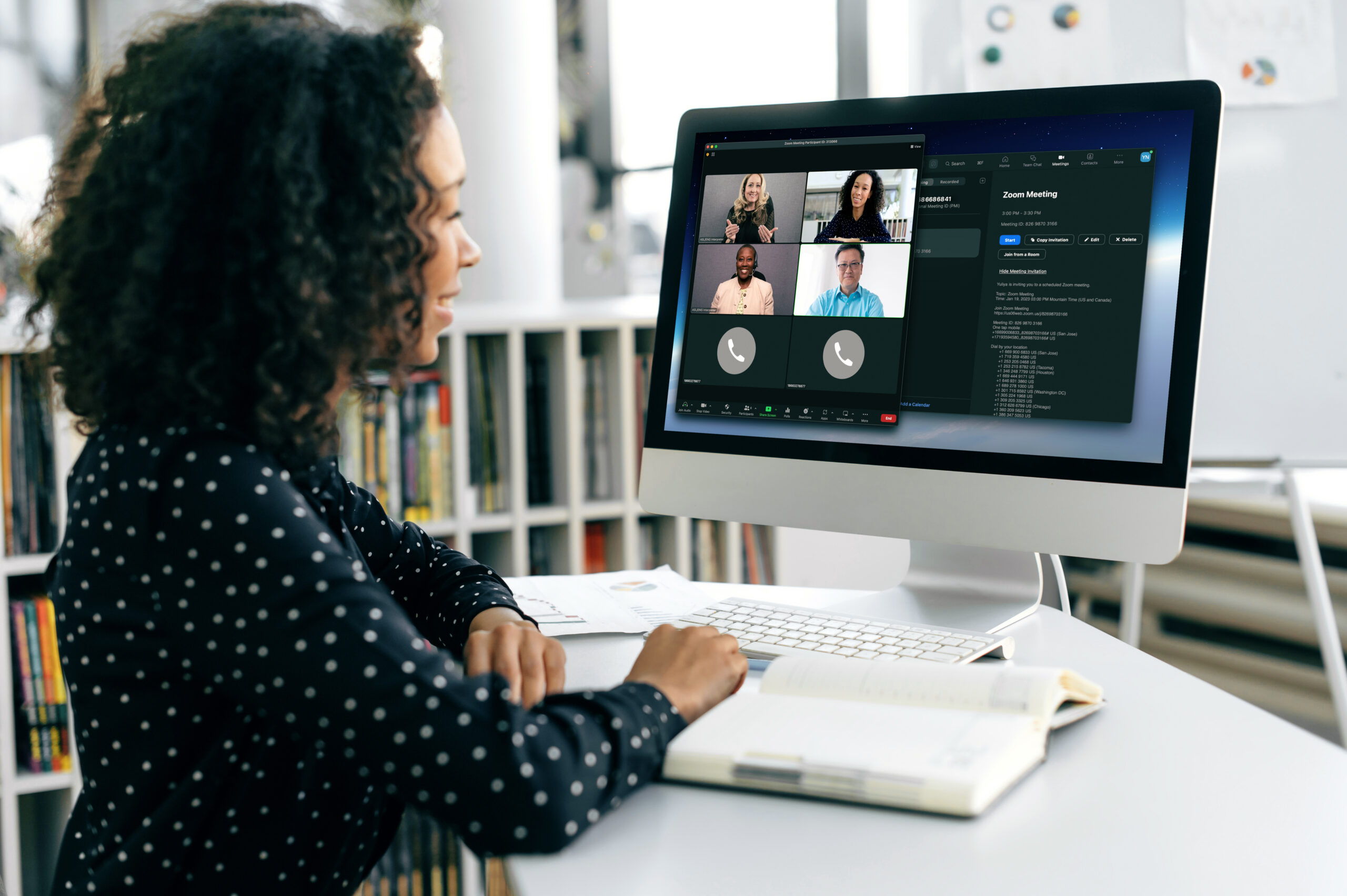
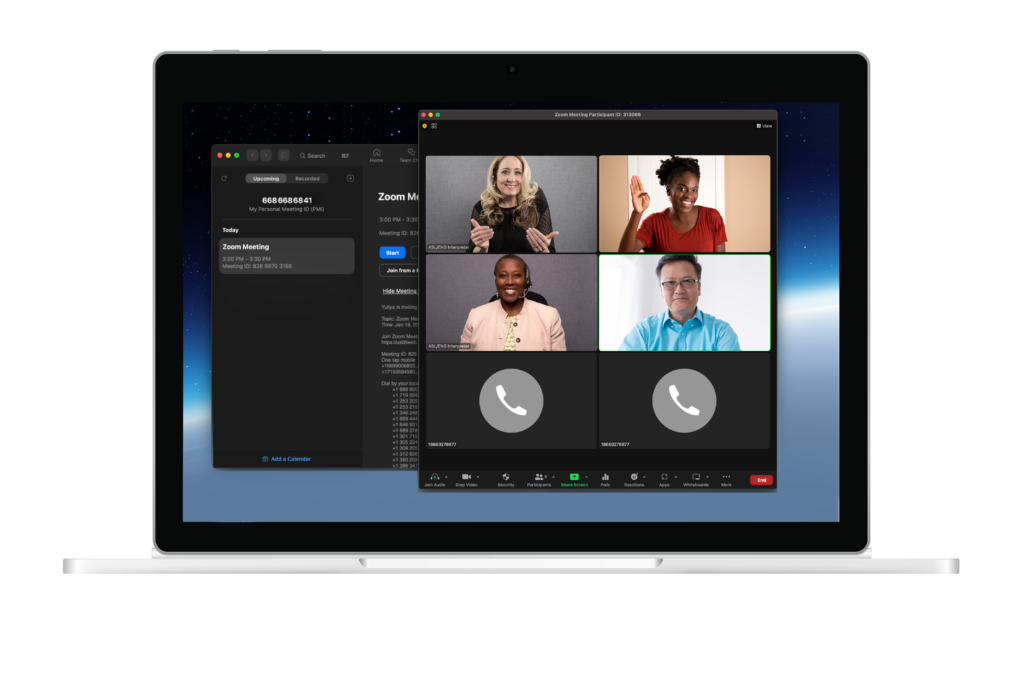
While videoconferencing apps such as Zoom and Microsoft Teams existed before COVID, the COVID-19 pandemic prompted an explosion in their popularity. Many businesses used these apps to continue operating. They also found widespread usage in families and friends who wanted a way to see each other when they were not able to visit in person. The arrival of Sorenson VRS for Zoom in Spring 2023 offered a new level of functionality for Deaf and hearing conversation, allowing an interpreter to join the meeting as a participant for fluid interpreter communication with everyone on the same screen.
Smartphones with cameras and videoconferencing capabilities
There are many smartphone apps that offer accessibility benefits for the Deaf and hard-of-hearing allowing users to pick and choose what’s helpful to them. For Deaf smartphone users, front-facing cameras introduced a wave of videoconferencing apps. Those apps include mobile VRS applications, like ntouch, so Deaf users can make and receive calls anywhere they take their phone.
Captioned phone calls
Phone call captioning (IP-CTS) is a no-cost service for hard-of-hearing people who need captions to use the phone. It provides real-time captions of their phone conversations on a specialized caption phone or a smartphone app.
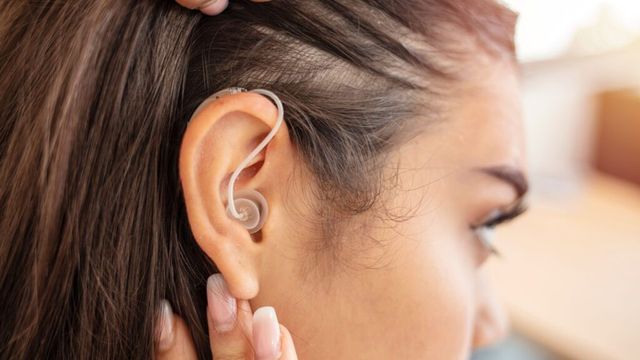
Hearing aids were the first “technology” to improve communication for people with hearing loss, and they have transformed over the years. Some hearing aids are now so small they’re practically invisible in your ears.
About two percent of adults aged 45-54 have disabling hearing loss, meaning they could benefit from hearing aids. That number trends upward with age: 8.5 percent of adults aged 55 – 64, 25 percent of adults aged 65 – 74, and 50 percent of adults aged 75+ have a disabling hearing loss that hearing aids may help with.4
The vast majority of people who could benefit from hearing aids do not use them. Only 30% of adults 70+ in that category has ever used them and only 16% of qualifying adults 20 – 69 have ever used hearing aids.4
Effort is the biggest factor in hard-of-hearing, hearing, and Deaf communication
Communication is critical to understanding. When the desire and effort is there, a shared language is not a necessary starting place. The effort you put into trying to communicate leads to greater understanding and a broader knowledge of other people. Personal stories suggest most of us aspire to connect beyond words.
We see the same adaptability in communication across hearing abilities in immigrant communities. When families span geography for various reasons — moving for a better life, escaping a bad situation, or uniting people from different backgrounds — and have children, those children typically are quick to learn new languages through exposure at school or friends. They can be a great example to the rest of us of how doing ones best to communicate can benefit all of us.
Putting forth the effort to communicate with people who may not hear or communicate the same way you do is a statement of value. Work together to make those connections. There are many apps available to communicate. There’s always good old paper and pen. And, if all else fails, gestures can be useful. Many are universal concepts: eat, drink, sleep, cry, laugh, love.
This concept is the one that matters with communication — if we care enough about each other, we’ll figure it out. Every family with Deaf, hearing, and hard-of-hearing people has proven that if you’re caring, patient, and willing to try, there are no insurmountable obstacles to connection across language and hearing ability.
By the time I reached the age of 5, I understood that the world was not built for people like me. Most importantly, I had this gut feeling that it was nobody’s fault. It wasn’t until college that I learned a new word: ideology. Two eminent thinkers influenced how I get the world around me: Louis Althusser and Stuart Hall.
“Ideology represents the imaginary relationship of individuals to their real conditions of existence.”
— Louis Althusser
“Race is more like a language than it is like the way in which we are biologically constituted.”
— Stuart Hall
To quickly sum up what I have come to realize: Everything that I have read or what others have told me about what being deaf means are made up. One example: because I don’t receive sound through ears does not necessarily mean that I cannot develop a language or a faculty for thinking.
Disability and accessibility as social constructs
So, here we are, talking about accessibility. The notion of “disability” and “accessibility” are also social constructs. The term “social construction” is fancy jargon for the concept that everything that eight billion people created through language is just that: a creation. We made it all up. If we can take a moment and realize that life is essentially empty and meaningless…until humans came along and started producing language, and thus created meanings for pretty much everything in life.
It’s not any one person’s fault that not everyone knows sign language and that interpreting service is expensive. Or that, although it’s possible to easily caption a regular phone call at high accuracy and speed with the help of the AI behind CaptionCall Mobile, call captioning isn’t universal. No one sat in a corner and came up with Machiavellian policies to deliberately make life difficult for some 16% of the world’s population that have a “disability”. Accessibility is actually just a word to describe an attempt to identify the engineering misconceptions resulting from thousands of years of ideological snowballing and “correct” them.
Principles of universal design
Quite essentially, accessibility in its current state is an afterthought (or oversight). If we were to consider universal design in the engineering of products to make them responsive to as many representations of humanity as possible, then we could move beyond accessibility as a corrective action. Universal design factors the lived stories of billions of people into one story — uni: one, verse: story — and expresses it in a functional design for everyone.
We all design our environment based on what works for us. It is only natural. When we employ others who are unlike us to collectively develop designs, we achieve greater universality simply because we incorporate experience that we don’t have.
Ramps for wheelchair users are not only enjoyed by them; they are immensely helpful to delivery people and parents with strollers. Captioning on television in public — for instance, in a loud restaurant or airport — is convenient and useful for more than Deaf and hard-of-hearing patrons. They are regarded as accessible only because the developers didn’t consider those use cases in the design from the beginning. If design were universal at its core, would you point out accessibility features or simply call it sensible, smart, and efficient?
The ability to communicate is essential to inclusion in professional, learning, or social settings. A Deaf employee, for example, can’t fully contribute to a business unless they can participate in impromptu meetings or hallway chats with colleagues. If English is a second language for a medical student, they need detailed and accurate notes to retain critical information. For a senior aging into hearing loss, losing the ability to connect with family members by phone can be devastatingly isolating. I know of this situation all too well — in my work as a sign language interpreter I’ve seen how connections can be lost when communication isn’t available or readily accessible
In all of these instances, inclusive communication facilitates involvement, acceptance, and belonging. Today, innovative technology is creating new opportunities for people of different backgrounds, experiences, and linguistic modes to seamlessly share information, collaborate, and engage. Three examples are outlined below.
On-demand access to ASL interpreters
American Sign Language (ASL) interpreters can allow a Deaf person to understand as well as converse with hearing counterparts. For most Deaf people, moreover, ASL is a native or primary language; as such, ASL interpretation provides linguistic equality by supporting a Deaf person’s ability to articulate ideas and thoughts fluently.
The challenge is accessibility. Bringing an interpreter onsite to a business or an event poses logistical, scheduling and supply and demand issues. While video conferencing simplifies things, interpreters have traditionally had to be scheduled in advance. For a business, that means Deaf employees can actively participate in live or virtual meetings that are pre-arranged, but they are largely excluded from informal discussions or urgent matters that arise.
Artificial intelligence and data analytics
Today, new services are emerging that allow Deaf users to virtually access an ASL interpreter on demand, via a Zoom call or other platform. This functionality is a potential game-changer for human resources and DEI strategies aimed at facilitating ongoing, real-time collaboration, and engagement. Similar services are being developed to enhance customer experiences for the Deaf. In a retail setting that provides such a solution, for example, Deaf shoppers can have on-demand access to ASL interpreters as soon as they enter a store, giving them the option to ask questions and engage with store personnel. Retail staff, meanwhile, can help Deaf customers find products, inquire about needs and preferences, recommend new offerings, and engage on a personal level. Here again, on-demand availability has a significant impact on communication, inclusion, and engagement.
To enable this capability, providers are leveraging Artificial Intelligence (AI) and data analytics to develop platforms that — similarly to ride-sharing systems — constantly monitor and match the supply and skill sets of available interpreters against demand for services from Deaf users. The intelligent tools also predict demand curves, identify potential trouble spots, offer work shifts and measure and monitor quality.
Real-time transcription
Communication Access Real-Time Translation (CART) services transcribe words into text or captions as they are spoken during a classroom lecture, business meeting, or public speech. For people who are Deaf or hard-of-hearing, who aren’t fluent in English, or who have auditory processing disorders, CART services support understanding and participation, particularly in higher education. CART also provides written documentation of an event in real time, and, when combined with signing interpretation, can reinforce learning and information retention for Deaf people (and, for that matter, anyone whose mind wanders during a lecture).
As with ASL interpreters, access to CART services has traditionally been limited. In addition to typing up to 260 words per minute, CART stenographers have required training in the specialized medical, legal, or scientific terminology used in university lectures. This has resulted in high costs, hard-to-find skill sets, and limited availability.
Smart tools plus smart people
Today, AI-enabled Automated Speech Recognition (ASR) computer software is becoming increasingly adept at replicating the stenographer’s role of transcribing text. Specifically, the software is getting better at understanding accents and jargon, and at analyzing word clusters to contextualize a discussion and accurately predict the words a speaker will use. Despite this progress, smart tools still can’t deliver CART services with the accuracy and understanding that many environments — such as a medical school lecture hall — require.
By complementing AI-enabled ASR with human intervention, providers are leveraging the respective strengths and capabilities of intelligent tools and human knowledge. Specifically, ASR applies processing speed and contextual analysis to do the bulk of the transcription, while human agents address nuances, ensure the accuracy of technical terminology, and correct errors. This greatly reduces the level of specialized training a CART captioning agent requires, which can significantly expand the availability of CART services to a wider audience. Easier access to CART services, meanwhile, creates new opportunities to improve communication and enhance inclusion for people with unique learning styles.
Speech-to-text transcription
CART services — which involve specialized terminology and require rigorous accuracy — rely on human intervention. Speech-to-text applications for smartphones, meanwhile, are entirely AI-driven, and are another example of how ASR can enhance linguistic inclusion. These easily downloadable apps convert speech to text in real time. During a cell phone call, one user’s spoken words are converted into text that appears on the other user’s smart phone screen, allowing one or both users to read along with the conversation. Speech-to-text transcription can be especially helpful for individuals with hearing loss because telephones don’t transmit the full range of frequencies used in human speech, so turning up the volume simply creates louder garbled sound. Text also helps those who have difficulty understanding certain accents or voices, or who may miss parts of the conversation due to background noise.
As with CART services, advances in AI technology and ASR algorithms are key. Today’s speech-to-text apps deliver real-time transcription with increasing accuracy, without the longstanding latency issues that, until recently, produced choppy text blocks and disrupted conversational flow. The applications’ ease of use is another important consideration, particularly for seniors aging into hearing loss who are often resistant to change and who struggle with learning to use new devices.
Inclusivity and accessibility comprise a wide range of criteria and characteristics. These include racial, gender, and ethnic identities, as well as belief systems and physical abilities. As public and private institutions, organizations, and businesses define new strategies to create more accepting cultures and environments, linguistic inclusion should be part of the conversation.
Kenya McPheeters is Director of Workplace Inclusion and Impact at Sorenson, a provider of language services for people who are Deaf, hard-of-hearing, or neurodiverse. She has a B.A. degree in Sociology from the U. of Louisville and is an accomplished leader and operations strategist. Kenya has managed cross-functional teams, consistently guided business growth, provided strategic counsel to senior executives, and restructured and realigned business processes. She has built a full-service ASL (American Sign Language) business from scratch, assuming responsibility for strategic planning, business development, P&L, marketing, advertising, budgeting, key account relations, and customer service.
Sorenson, a leading language services provider, offers a variety of technology solutions and tools for people with diverse communication needs. These include call captioning, sign language and video services for deaf and hard-of-hearing people, as well as language translation and interpreting services.
While traditionally focused on consumer markets, the company recognized that demand for its services was growing among enterprise customers. Large businesses, universities and government entities, for example, are increasingly focused on providing accessible and inclusive communication options. Captioning, transcription and video services, moreover, can play a role in post-pandemic workplace models designed to facilitate collaboration among employees in disparate locations.
In addition to transitioning to an enterprise model, Sorenson aimed to extend its services to reach new geographies and populations. This would boost revenues, as well as advance the company’s commitment to providing inclusive and accessible communication services to historically underserved communities. To achieve these objectives, Sorenson would need to transform the company’s existing operational model to enable global reach, rapid response to customer requirements and scalability of scarce skill sets.
Scaling access to real-time captioning
Communication Access Real-Time Translation (CART) services transcribe words into text or captions as they are spoken during a classroom lecture, business meeting or public speech. For people who are Deaf or hard-of-hearing, who aren’t fluent in English or who have auditory processing disorders, CART services are essential to enable understanding and participation, particularly in higher education. Moreover, CART provides written documentation of an event in real time, and, when combined with signing interpretation, can reinforce learning and information retention for Deaf people.
Traditionally, CART services have required highly skilled stenographers who — in addition to being able to type up to 260 words per minute were familiar with the arcane medical, legal or scientific terms being used in a university lecture. As a result, an organization’s ability to provide CART services has often been limited by high costs and hard-to-find skill sets.
That is changing, as Artificial Intelligence (AI) and speech recognition capabilities are advancing on several fronts. For one thing, Automated Speech Recognition (ASR) computer software is getting better at understanding accents, jargon and vocal inflections, as well as filtering out background noise. In addition, natural language processing models are deploying deep learning techniques to analyze word clusters and more accurately predict the words that a speaker will use. This is important, since — unlike readily available tools that can accurately transcribe audio recordings after analyzing the entire discussion — CART applications must conduct the contextual analysis on the fly.
Human in the loop
Despite this progress, AI-enabled automated tools on their own are still not capable of delivering CART services with the accuracy and understanding that many environments require. Sorenson’s CART solution supplements AI-enabled ASR with human intervention, thereby leveraging the respective strengths and capabilities of intelligent tools and human knowledge. Specifically, ASR applies processing speed and contextual analysis to do the bulk of the transcription, while human agents address nuances, ensure the accuracy of technical terminology and correct errors.
The practical impact of this machine/human interface is to significantly reduce the specialized training human captioning agents require, in terms of both stenography (typing speed) and subject matter expertise. As a result, CART services become dramatically more accessible, affordable and scalable. Easier access to CART services, meanwhile, can create new opportunities to improve communication and enhance inclusion for people with unique learning styles.
On-demand ASL interpretation
Seamless access to workplace, educational and social collaboration tools is another critical enabler of linguistic and communication inclusion. A Deaf person, for example, can effectively communicate via video conferencing with the support of an American Sign Language (ASL) interpreter. The trouble is, interpreters typically must be scheduled in advance, thereby limiting flexibility and utility.
To address this obstacle, Sorenson recently introduced a first-of-its kind service that allows Deaf users to initiate or join Zoom calls and access an American Sign Language (ASL) interpreter on demand. In terms of workplace and human resources DEI strategies, this functionality has a huge impact for Deaf employees, as it supports inclusion in spur-of-the-moment meetings and facilitates ongoing collaboration with hearing colleagues.
To enable on-demand interpreter scheduling on a wide scale, Sorenson developed a sophisticated Uber-type system that constantly monitors and matches the supply and skill sets of available interpreters against demand for services from Deaf users. The Sorenson platform continues to evolve through the use of AI to predict demand curves, identify potential trouble spots, offer work shifts and measure and monitor quality.
Cloud-based globalization
Expanding the scope and reach of Sorenson’s services also necessitated a shift to a flexible and agile cloud-based delivery model — a shift that fundamentally redefined how the company deploys technology. Rather than ordering hardware, waiting for delivery and then sending a team onsite to install, Sorenson now uses code to spin up new infrastructure virtually. This greatly streamlines the implementation and integration of services in new geographies, ranging from isolated counties and communities to new global markets. In addition to providing the scalability needed to cost-effectively support growth, cloud-based delivery provides the flexibility to pivot rapidly should requirements change.
Transitioning to cloud also improved quality of service by enabling deployment of advanced network compression technology. Because ASL involves hard-to-detect subtleties and nuances. Sorenson’s customers rely on clarity and availability of both video and sound that only high-performing platforms can deliver, and that are hard to replicate with on-premise legacy infrastructure.
Cloud migration was accompanied by a redesign of business processes to rationalize orders, billing and invoicing, along with consolidation of call center operations. These changes streamlined a recent expansion into the UK market and position the company to integrate new language services in the future.
For more than 20 years, Sorenson has focused on delivering inclusive language and communication services to diverse communities. Innovation in digital technology is allowing the company to dramatically expand the scope and scale of that mission.
About the author
Jason Dunn
Jason Dunn is Chief Operating Officer of Sorenson, a provider of language services for the Deaf, hard-of-hearing and those with diverse communication needs.
The most common service-connected disabilities for American Veterans are hearing loss and tinnitus, which is a ringing or buzzing in the ears. An estimated 3.6 million Veterans receive compensation for hearing loss or tinnitus.1 And this impacts Veterans from every war from World War II through the Korean, Vietnam, and Gulf Wars, as well as those who served during peace time.
Compared to the general male population, 11% fewer male Veterans have good to excellent hearing while 10% more have at least moderate trouble hearing.2
Both hearing problems and tinnitus can impact quality of life and communication. Both also contribute to isolation, frustration, and even depression without intervention.
We sat down with audiologist Stephen DeMari, who is also Sorenson’s director of business development and education, to talk about Veterans and hearing loss due to military service.
Why talk to Stephen about hearing loss in Veterans?
Stephen has more than 30 years of experience in the audiology and hearing aid industries. He earned his master’s degree in audiology from Syracuse University. He then completed a clinical and research audiologist fellowship at the Department of Veterans Affairs Medical Center in Long Beach, California. He’s a member of both the American Academy of Audiology and the American Speech-Language-Hearing Association.
Q: Do Veterans have different types of hearing loss than the general population?
A: No. There are different types of hearing loss. Conductive hearing loss occurs in the outer and/or middle ear. It can be caused by debris, excess ear wax, disease, or trauma.
Sensorineural hearing loss (SNHL), results from noise exposure, age, disease, or a combination of these. It involves the inner-ear and/or auditory nerve. It’s usually the result of damage to the hair cells in the inner ear. Severity of SNHL can be mild to profound.
SNHL is the most common type of hearing loss for Veterans and non-Veterans. Veterans most commonly suffer from high-frequency SNHL, which means they struggle to hear high-pitched sounds.
Q: What are some of the causes of hearing loss for Veterans?
A: Hearing is a complex mix of three parts of our ears. Sound waves vibrate tiny bones in our ears and those vibrations create waves that interact with hair cells in our ear and create an electric signal that the brain interprets as sound.
That’s a very basic and abbreviated description. The complexity of it creates a number of opportunities for aging, noise exposure, disease, and heredity to affect hearing. Still, the most common cause of hearing loss is loud noise.
Hearing loss for service members results from gunfire, aircraft, tanks, bombs, and trauma from blast explosions. With noise-induced hearing loss (NIHL), the longer the exposure and the more intense sound, the greater the damage that occurs.
A lawn mower has a decibel level of about 95, while military guns range in the 150 decibels. Grenades and louder explosives can exceed 170 decibels. Anti-tank fire can approach 190 decibels. A single grenade or tank blast can cause immediate and permanent hearing loss. Anything over 140 decibels instantly damages nerves. Exposure to 130 decibels can cause permanent damage with as little as 30 minutes of exposure. Q: What are some of the symptoms a veteran may experience with hearing loss or damage?
A: Symptoms depend on the severity of impact. Tinnitus isn’t hearing loss but a sensation of ringing, buzzing, clicking, or even roaring in one or both ears. It can seem like an engine or appliance is always running nearby. For some people, it’s loud and persistent enough to be debilitating.
A feeling of fullness in the ears can be a symptom of hearing loss. It can feel something like needing to pop your ears when you go up in elevation. Other symptoms of general hearing loss include:
Asking people to repeat themselves or misunderstanding what they say
Needing the television volume louder than normal
Difficulty understanding speech, especially in the presence of background noise
Fatigue after conversation, which results from struggling to listen
Missing the phone or doorbell ringing
With high-frequency SNHL, Veterans might struggle to hear consonants. Speech will sound like mumbling.
Often, it’s the people a veteran interacts with who first notice a change in a veteran’s hearing.
Q: Does hearing loss only affect older Veterans?
A: Hearing loss can affect Veterans of any age. It can also affect them while still actively serving. As I mentioned, exposure to a loud enough sound, such as tank fire, can damage hearing immediately and permanently. And as we grow older, our cognitive ability to understand speech naturally declines, as does our hearing sensitivity.
If exposed to sustained, unprotected noise levels during combat or training, a service member can experience hearing loss and/or tinnitus. High-frequency SNHL is the most common form among Veterans, old and young.
Q: Are there things Veterans and active-duty service members can do to prevent hearing loss?
A: The only preventative methods are avoiding the noise and wearing hearing protection when possible. Ear plugs offer 30 to 40 decibels of attenuation (sound reduction). The military does buy and provide a lot of ear plugs. Earmuffs — like the headphones you see naval servicemen wearing — are another option. Some helmets also have built in hearing protection. Over time though, even with hearing protection, loud noise can damage hearing.
These devices help during active duty, but a veteran exposed to loud noises who didn’t have these options has likely already suffered damage. And even though they may not yet have symptoms of NIHL, their hearing may have been damaged. Options there include Veterans Health Administration (VHA) programs that offer further NIHL prevention and aural rehabilitation services to optimize remaining hearing.
Definitely, any inactive veteran should take the same precautions to protect their hearing as everyone should by avoiding loud noise and wearing hearing protection when using power equipment.
There are a variety of things anyone can do to naturally protect their hearing. Q: What can vets do if they’re experiencing symptoms of hearing loss and/or tinnitus?
A: It’s important to see an audiologist. A vet can do that through their local Veterans Affairs Medical Center (informally called the VA). The U.S. Department of Veterans Affairs website is a great place to start if you don’t know your local VA yet.
In some cases, the effects of tinnitus can be alleviated by a hearing aid or tinnitus program.
Q: Can a vet just see their non-VA doctor or audiologist?
A:Vets can see any doctor they choose. If they qualify for the Veteran’s Choice Program, their care for a covered non-VA doctor is covered under their VA benefits. The potential advantage of using a VA medical facility is that those practitioners specialize in helping Veterans with issues, including hearing loss, due to military service.
Q: Are VA audiologists licensed professionals?
A: Yes. Each of the over 1,000 audiologists employed by the VA must hold a state license and participate in continuing education according to state regulations. And the Veteran’s Health Administration (VHA) operates the nation’s largest audiology program with audiologists at 400 locations. So, whether a vet chooses their own provider or a VHA provider, they have access to excellent care. Q: How do Veterans get a hearing test with the VA?
A: Once enrolled for medical services at a VA facility, they can arrange for an audiometric test. If they’re deemed eligible for hearing aids, they’ll be scheduled for a fitting as well.
Many hearing aids can be adjusted remotely through the VA’s live video conferencing service, VA Video Connect. Veterans can contact their nearest VA audiology clinic to see if telehealth visits are available in their area.
Q: Do VA benefits cover hearing tests, hearing aids, and cochlear implants?
A: They do if the hearing loss is related to military service. Vets can get their hearing aids, hearing aid batteries, and related appointments covered under their VA benefits.
The VA also covers cochlear implants, which are devices that are surgically placed in the skin and used with an external device to transmit sound directly to the auditory nerve. Cochlear implants are sometimes the only option when hearing loss is significant enough or beyond the scope of hearing aids.
If a vet’s hearing loss is deemed to not be service-connected, Medicare may pay for hearing aids for older vets.
Q: Does the VA provide the latest hearing aids and cochlear implants?
A: Yes. For eligible vets, the VA dispenses hearing aids from the top six manufacturers, GN Resound, Oticon, Phonak, Siemens (Signia), Starkey, and Widex. The devices provided by the VA are actual premium devices that sale for the highest prices in the non-veteran sector.
They also offer cochlear implants from three FDA-approved cochlear implant manufacturers, Cochlear Corporation, Advanced Bionics, and MedEl.
Q: Does the VA offer other hearing solutions for vets?
A: Yes. The VA also offers FM systems, which are frequency modulated (FM) systems. With such a system, someone speaking wears a small microphone that is transmitted to a receiver worn by the person with hearing loss. The transmitter can even be attached to a hearing aid.
Vets also have access to TV amplifiers and transmitters, remote microphones, and internet protocol (IP) captioned telephone service through the VA and other programs and based on their needs.
A TV amplifier works like an FM system but with a TV.
Captioning apps are available. And captioned telephone service uses either a specially designed phone or a smartphone to turn spoken phone conversations into readable captions. Captions on a TV or show can also help. Studies have shown that captions can help with comprehension, even when someone wears hearing aids.
There are also aural rehabilitation programs, including some offered by the VA, designed to help reduce or compensate for hearing loss.
Whether a vet has symptoms of hearing loss, practicing good hearing hygiene is always a good idea as well.
Q: How can Veterans get captioned telephone service for hearing loss?
A: Sorenson and other providers offer captioned telephone service to vets and others with hearing loss that requires they have captions to use the phone effectively.
Sorenson offers both CaptionCall and CaptionCall Mobile app by Sorenson to help vets with hearing loss stay connected. CaptionCall transcribes phone conversations using a specially designed phone with a screen for captions. CaptionCall Mobile is a smartphone app that captions calls on a mobile phone.
Q: How do Veterans qualify for captioned telephone service?
A: Captioned telephone service is available at no-cost to anyone with hearing loss that necessitates the use of captioned telephone service to use the phone effectively. Vets who meet this eligibility requirement can access the service through their audiologist by self-certifying they need it when they enroll.
Q: Do Veterans need to have internet access to use CaptionCall or CaptionCall Mobile service?
A: No. Anyone who qualifies, including Veterans, can get captioned telephone service without internet access on select phones. And all that’s needed to use the CaptionCall Mobile app is a Wi-Fi connection or mobile (cellular) data connection.
If you haven’t worked with a sign language interpreter before, it will take some getting used to, and the guidelines for using an interpreter may not be intuitive. Even if you’ve worked with an interpreter before, you may need to adjust when you use interpreter services in a new way — such as on-site interpreting vs video remote interpreting (VRI) vs video relay service (VRS).
While Deaf individuals who use sign language may have more opportunities to work with an ASL interpreter than hearing people, the skills it takes to work well with an interpreter aren’t automatic. Deaf people who have the best interpreting experiences developed those skills with practice. You can too.
Guidelines for using a sign language interpreter
Guidelines for interpreted communication are a little different than same language conversations. Even people who have some experience using an interpreter may benefit from learning the best practices.
Guidelines for interpreter use will vary slightly depending on what type of service you’re using.
We’ve put together a guide to getting the best experience with an ASL interpreter for video remote interpreting (VRI) with tips for each step along the way:
Being thoughtful about each step in the process will improve your experience working with a sign language interpreter.
Sorenson’s interpreting expertise
Sorenson employs the largest private sign language interpreter workforce in the world, with a team of more than 6,000 interpreters globally. The company designed and operates the most comprehensive internal and external sign language interpreting training program on earth to develop top interpreter talent for its own team and other public and private entities for an exceptional customer experience.
Our American Sign Language interpreting services include VRS, on-site interpreting, and video remote interpreting (VRI). Those services cover virtually any interpreting need: from medical settings to work meetings, in-person and online classes, conferences and conventions, closing on a home or booking a contractor for the renovations. Eligible Deaf individuals are welcome to sign up for VRS to request any of our video relay products. Deaf or hearing businesses and individuals interested in on-site or video remote interpreting can contact our team to discuss options and pricing or help you schedule service.
Sorenson is also one of the largest employers of Deaf people in the U.S. Our employees use VRI and on-site interpreting daily for meetings between Deaf and hearing employees. Experts have vetted these guidelines for effective use of sign language interpreters.
That’s why Amazon Web Services (AWS) is working with Sorenson to optimize its virtual training programs, implementing insights about making virtual learning accessible for Deaf and low-vision participants not only through content, but through effective use of VRI services for virtual classrooms.
Choosing the right interpreter services
There are multiple factors to consider to determine whether video remote interpreting (VRI), on-site interpreting, or video relay service (VRS) is the best fit for your needs.
Video relay services (VRS) is a convenient option for everyday conversations for phone and video calls when Deaf and hearing people are in different locations. It’s a federally funded service, with the FCC covering the costs of VRS calls so users don’t pay out of pocket, but that also means there are strict regulations on its use:
Only Deaf individuals who communicate using sign language can have VRS accounts.
Deaf and hearing people can only use VRS to communicate from separate locations; they can’t be in the same room/place.
Interpreters must verify that an eligible Deaf individual is on the line for the entire VRS call, so the user can’t turn off their camera. That makes webinars ineligible for the service.
If you want to know more about VRS, you can read it here: What is VRS?
On-site interpreting is where it all started; before video calls and high-speed internet, ASL interpreting services meant a sign language interpreter showed up in person to relay communication between signed and spoken languages.
In-person interpreting offers optimal interaction for face-to-face events, but also requires the most advance notice.
Scheduling on-site interpreter services involves consideration for travel time and costs. Because of this, there may be a minimum session length for scheduling on-site services.
On-site sign language interpreting is a fee-based service. Costs vary by provider.
Video remote interpreting (VRI) combines the convenience of VRS and the flexibility of interpreting for remote or face-to-face conversations:
An ASL interpreter relays communication between signed and spoken languages over video through a high-speed internet connection.
The Deaf and hearing individuals can be in the same location with a video screen or in different locations using videoconferencing software.
VRI is a fee-based service, with costs varying by provider for scheduled or on-demand service options.
If VRS isn’t right for your situation and you’re torn between on-site interpreting or VRI, our interpreting services comparison sheet may help you choose the best fit for your needs.
You can also ask the other person(s) about their preference. Deaf individuals in particular may have more experience with the different options for using a sign language interpreter and have valuable insight into which is the best choice for effective communication at your meeting or event.
Preparing for interaction with an ASL interpreter using VRI
Give your interpreting service provider information to suitably staff and plan for your session.
Make arrangements for mutual visibility and audibility for everyone in your conversation and the sign language interpreter.
Part 1: providing information
When you schedule video remote interpreting service, your provider will review the details of your request to assign the right interpreter(s) to your session.
For example, depending on the length of your session and/or the number of participants, you may need a team of interpreters. Interpreter teams improve the flow of conversation, with two or more interpreters simultaneously voicing and signing for Deaf and hearing participants to reduce delays. They also allow pairing interpreters who bring different skills to the table. For example:
A team can facilitate multilingual interpreting for conversations that include ASL, English, and Spanish users.
A Deaf/hearing interpreter team pairs a hearing interpreter making the conversion between spoken language and ASL with a Deaf interpreter relaying messages as a native ASL user. This can provide more accurate interpreting for cultural nuance between Deaf and hearing communities. That may be especially important in high stakes conversations, like health or legal settings.
When scheduling Sorenson VRI in advance, you have the option to select for specialized interpreting services, including: legal interpreting certification, certified medical and mental health interpreters, Certified Deaf Interpreters, interpreters with additional training in Deafblind or low-vision interpreting, or industry-specific knowledge which may be particularly helpful in STEM fields.
Not only can you select for interpreter expertise/background when you schedule VRI, you can provide your interpreter with information to prepare for your session; that prep will help them effectively relay your statements in spoken and signed languages. For best results, include:
The topic(s) and agenda of your conversation, meeting, or event;
Unfamiliar names of key people, places, brands or products likely to come up in your session; and niche terminology for your company or industry pertinent to the topic(s) of conversation
Part 2: logistical arrangements
Because VRI relies on videoconferencing software over a high-speed internet connection, it’s critical that you verify the reliability of your internet service and your conferencing platform before your session. This applies to use cases in person with participants using a shared screen to access interpreting services and to virtual meetings with participants joining from separate locations. A few minutes before your meeting or event is not the right time to test your connection, video, and audio for the first time.
Whether you’re meeting virtually or only the interpreter is connecting to your meeting over video conferencing software, we recommend you open that connection about 10 minutes before your meeting or event begins. That will allow you time to test video and audio, coordinate with your interpreter, and figure out how to pin or spotlight your interpreter(s).
For in-person meetings or events in particular, the physical setup of your video screen and speakers is important. Ideally, everyone should be able to see and hear the interpreter and, likewise, be visible and audible on the camera and microphone.
Full visibility and audibility may be difficult for large spaces and large groups. In those situations, consider multiple screens for interpreter visibility throughout the space and multiple microphones and speakers for hearing participants and the interpreter.
In any VRI setup, you should always put thought into:
Lighting: adequate lighting for participants so the interpreter can see them clearly on camera (including avoiding backlighting from windows) and minimizing glare on the screen so participants can clearly see the interpreter.
Positioning the video screen, speaker, and microphone to avoid obstruction, discomfort, or distraction.
Learning and using interpreter etiquette
Etiquette for using a sign language interpreter is not necessarily intuitive. That goes for Deaf and hearing users alike. Learning the dos and don’ts for working with an ASL interpreter will make your interactions smoother and more effective for everyone involved.
Show your face: This may not be feasible throughout a meeting or event with a lot of participants, but when you’re taking a turn, it’s helpful for the interpreter and the others in the meeting to see you—for identification and unspoken context.Your facial expressions and body language convey more than your words alone for better understanding of your tone and meaning. So if you’re on a conference call, turn on your camera; if you’re in an in-person meeting, stand up or raise your hand.
Take turns: Because your interpreter is relaying what everyone is saying, multiple people can’t “talk” at the same time.Wait for the interpreter to finish signing or voicing what the last person said before you jump in with your comments or questions so everyone has a chance to take in the previous statement. It also prevents the interpreter having to process your comment while still relaying the last one. Hand-raising (either physically if you’re in person or have your camera on or using the feature on your video conferencing software if your camera is off) will come in handy to take turns contributing.
Identify yourself: Especially in a large group, identifying yourself by name allows the interpreter to share whose comments they’re relaying, which provides helpful context for those who cannot see or hear you.
Slow down: It’s not a race. You’ll need to adjust to more pauses, not only for the interpreter to finish relaying your statements, but also for participants to switch between referencing visual materials (like shared screens, media, or handouts) and the interpreter.While many Deaf individuals are adept at processing complex visuals, they can’t watch the interpreter and read your spreadsheet at the same time, just like hearing people can’t actively listen to music and a phone call at the same time.When you’re presenting slides or media, allow additional time for everyone to look it over and ask questions, and confirm they’re ready before moving on. If you’re in a virtual meeting and want to share your screen, pause for Deaf participants and interpreters to pop out video boxes so they can see each other during your screen share, and ask them to confirm readiness before you proceed.
Address the person you’re talking to: Look at and talk to the people in your conversation, not the interpreter. Of course, Deaf individuals need to watch the interpreter to receive spoken comments in ASL, but will face the person/people they’re addressing when making their own statements. Eye contact is essential in ASL. Looking at someone — whether you’re talking or listening to them — indicates they have your attention.The role of the sign language interpreter is to be a resource in your communication rather than an active participant. You aren’t hurting their feelings by focusing on the other person/people in your conversation rather than them. It’s polite to greet them at the beginning of the session and thank them at the end, but otherwise focus on the people in your meeting.
Don’t say things you don’t want interpreted: You should expect everything you say — whether spoken or signed — to be for everyone. Your sign language interpreter is professionally bound to relay all comments.Using language services — and interpreting services in particular, here — is a way to communicate more equitably and inclusively, so avoid excluding people from parts of the conversation.
You now know the basic guidelines for using an interpreter for VRI
Congratulations on making it this far. You’re now poised to successfully use video remote interpreting for better communication, collaboration, and connection in Deaf and hearing conversations.
Some of these guidelines may take practice to become comfortable — even second nature — but we promise you, using a highly trained, professional sign language interpreter can be as fluid and effective as same-language communication.
Video Relay Service (VRS) is available through the Telecommunications Relay Service (TRS) program. It provides interpreting services to the Deaf via communication through videophones using American Sign Language (ASL). The Federal Communications Commission (FCC) manages the TRS program as a requirement under the Americans with Disabilities Act (ADA) of 1990 as well as the TRS fund that pays for it.
VRS is a no-cost, subscriber-based service for Deaf people with a qualifying hearing loss who use ASL and have videophones, smart phones, tablets, or computers that are set up for video communication. VRS started when videophones were first available to users in 2003.
What is a videophone?
A videophone is a device that connects directly to the internet and is used to send and receive video and in some cases audio. It may be a standalone device that includes a camera and screen all in one, or it can be a device that contains the camera and other processing equipment that mounts on a separate screen such as a TV or computer monitor.
What is the TRS fund?
The TRS fund covers the costs of the TRS program and, therefore, VRS. The money comes from a small surcharge on everyone’s telephone bills. The charge may not be obvious by name and may be wrapped up with other charges.
It also pays for other relay services such as Teletypewriter (TTY) relay, caption relay, and call captioning services. (These relay services are for Deaf and hard-of-hearing people who use devices other than videophones.)
How is VRS used?
A Deaf person subscribes — or signs up with — a VRS provider certified by the FCC. The VRS service assigns a local 10-digit phone number and password to the subscriber. They use the number and password to log into a videophone or video relay app from the VRS provider. Users can install these apps on devices set up for video communication such as a smart phone, tablet, or computer.
When a Deaf person makes an outgoing call through VRS, they dial the number they want to call through the videophone or app. That call, by default, goes through the VRS provider they subscribed with.
An interpreter working for the VRS provider answers the call and checks to see if the Deaf person has any instructions for the call. Then the interpreter connects with the other end of the call. The interpreter communicates with the Deaf person using ASL and with the hearing person using spoken English. Some VRS services also provide interpreters that speak and translate Spanish into ASL.
Are there any limitations to VRS?
Deaf people aren’t limited in how many VRS services they can subscribe to. They aren’t limited to using only the VRS service that assigned them the local 10-digit number they used to log into the device they are using to make the call. They can dial another VRS service and give the interpreter the number of the hearing person or company they want to call, even if they aren’t subscribed to that VRS service. VRS is only for use in the same manner as typical telephone use. Users can’t make VRS calls to someone in the same room, for example. There is no cap on the number of calls they can make or the length of a call.
Hearing people don’t need to subscribe to a VRS service. And they don’t need to wait for a Deaf person to initiate a call. If they call a Deaf person using the Deaf person’s VRS phone number, they’ll connect to the interpreter and then the Deaf person using the same process.
What is Video Remote Interpreting (VRI) and how is it different from VRS?
Video Remote Interpreting (VRI) is an interpreting service for situations when VRS or in-person interpreting isn’t available.
VRS and VRI serve different purposes and are funded differently. The TRS fund pays for VRS and that service is for telephone calls between people who are not in the same location. The user pays for VRI, but that also allows more flexibility in usage.
VRI fills the gap between VRS and in-person ASL interpreting. There are many circumstances where it’s not feasible for an interpreter to be present in-person but VRS isn’t an option because both the Deaf and hearing people in the conversation are in the same room.
VRI is similar to VRS in that VRI calls connect over a high-speed internet connection via a video conferencing platform. But users can’t access a VRI service by dialing the phone number of a VRS service and the TRS fund doesn’t pay for it. Just like in-person interpreting, one of the users — usually a business or organization such as a doctor’s office or a company that employs or is interviewing a Deaf person — has a contract or account with a VRI provider and has a contact number to use.
What is Sorenson Video Relay service?
Sorenson Video Relay service is an easy and convenient solution for both deaf and hearing users to communicate between their primary languages. Sorenson offers both videophones and apps for desktops and smartphones that are designed for and with the Deaf. Sorenson’s 6,000+ interpreters are screened and trained to offer the best ASL interpreting available.
This site is registered on wpml.org as a development site. Switch to a production site key to remove this banner.