














































Captioning Glossary: Terms You Should Know
Captioning is used in more places than most people realize — on television, in movies, during phone calls, at live events, and on social media. The terms can be confusing, especially because many of them are often used interchangeably when they actually describe different things.
This glossary will outline some of the most common captioning terms in plain language. If you're exploring captioned phone services for yourself or someone you care about, this is a good place to start.
Captioning terms to know:
Captioned Telephone *(also: caption phone, captioned phone)*
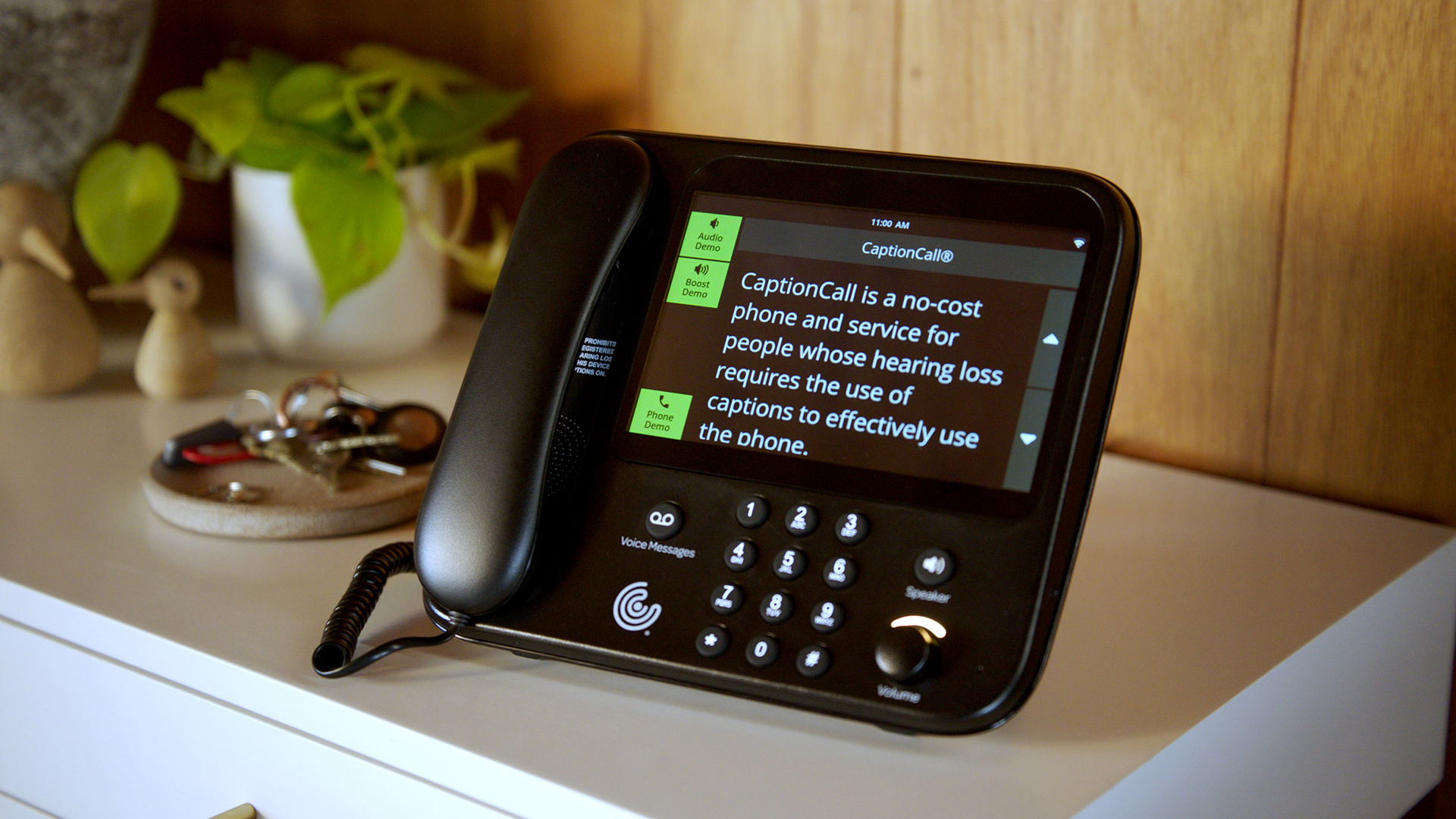
A telephone that displays real-time captions of what the other person is saying during a phone call. The user can listen and read simultaneously, making calls accessible for people who have difficulty hearing clearly on the phone.
CaptionCall is a captioned telephone service that comes with your own captioned telephone for your home. Learn how CaptionCall works.
Captioned
What does “captioned” mean? Something described as "captioned" has text displayed alongside audio or video to represent spoken content. A "captioned movie" has text captions available.
A "captioned telephone," for example, displays text of what the person on the other end of the call is saying. "Captioned" indicates that a spoken-language accessibility feature is present.
CaptionCall is a captioned telephone service that comes with your own captioned telephone for your home. Learn how CaptionCall works
Captioning
The process of converting spoken words into text that is displayed on a screen. Captioning can be done live (real-time) or after the fact (post-production). It's used in television, film, telephone services, live events, and video content.
Captions vs. Subtitles – While similar, and often used interchangeably, captions and subtitles each serve a different purpose. Captions are intended to provide accessibility to deaf and hard of hearing individuals, so they include all dialogue as well as speaker identification and descriptions of audible sounds. Subtitles are primarily intended for people who can hear but cannot understand the language being spoken.
Captioning accuracy
A measure of how closely the captions match what was actually said. Accuracy is expressed as a percentage — 99% accuracy means 1 word in 100 is incorrect or missing. In real-time captioning (like phone calls), accuracy depends on speech recognition technology and, in some services, human editors working in real time.
Closed captions *(abbreviated: CC)*
Captions that can be turned on or off by the viewer or listener. The word "closed" refers to the fact that they are not permanently part of the picture or audio — they're hidden until activated.
Closed captions are the standard for television in the United States, where the FCC requires them on most broadcast and cable content. On streaming platforms, closed captions appear as a setting the viewer can enable.
For phone calls, CaptionCall provides what functions as closed captioning — captions of what is being said on the call, which you can turn off when not needed.
*Compare to: open captions*
FCC (Federal Communications Commission)
The U.S. government agency that regulates communications, including telephone and broadcasting. The FCC requires closed captions on most broadcast and cable television programming and funds captioned telephone services through the Telecommunications Relay Services (TRS) program.
Hard of hearing
A term used to describe people with some degree of hearing loss who are not fully deaf. People who are hard of hearing may use hearing aids, cochlear implants, visual communication strategies, captioning tools, or some combination of these options to help with communication.
"Hard of hearing" is generally preferred over the term "hearing impaired" by people within the hearing loss community, as it describes the person's functional experience rather than framing hearing loss as a deficit.
Hearing impaired
An older term used to describe people with hearing loss. While still used in some legal, medical, and government contexts, many people with hearing loss prefer "hard of hearing" or "person with hearing loss." Both terms are sometimes used to describe the same group of people.
IP Captioned Telephone Service (IP CTS)
A form of Telecommunications Relay Service (TRS) for phone captioning that uses the internet to provide real-time captions for phone conversations. CaptionCall is an IP CTS provider.
IP CTS is funded through the FCC's TRS program. Federal law requires that users of IP CTS have hearing loss that makes captions necessary to communicate effectively on the phone.
Live captioning (also: real-time captioning, or CART)
Sometimes referred to as “real-time captioning” or “Communication Access Realtime Translation (CART).” A service that generates and displays captions as speech is occurring — not after the fact. Live captioning is used in phone calls, courtrooms, classrooms, and at live events.
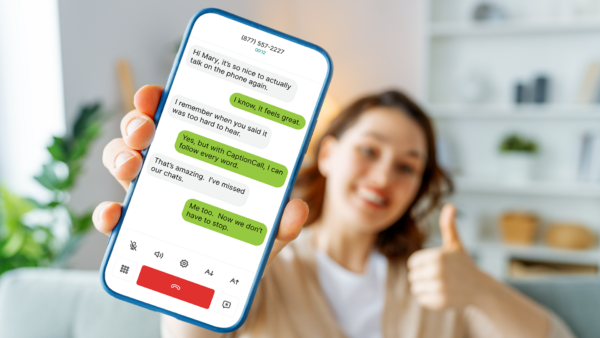
For phone calls, CaptionCall provides live captioning using a combination of human captioning agents and automated speech recognition technology. Captions appear on the phone screen as the words are spoken.
Open captions
Sometimes referred to as “burned-in captions” or “hardcoded captions.” Captions that are permanently part of the video or content and cannot be turned off. Unlike closed captions, open captions are always visible to everyone watching, regardless of their settings.
Open captions are commonly used in social media videos (where audio is often off by default), films shown at accessible screenings, and content intended for audiences where captions are always expected.
*Compare to: Closed captions*
Closed captions vs. open captions: The key difference is control. Closed captions can be turned on or off. Open captions are always on. Neither is better — they're designed for different situations
Real-time captioning
Sometimes referred to as “Communication Access Realtime Translation,” or “CART.” Captioning generated and displayed at the moment speech is happening. Historically performed by trained stenographers, real-time captioning today is increasingly powered by automated speech recognition (ASR) technology, sometimes with human editors to improve accuracy.
Speech recognition
Technology that converts spoken words into text. Some modern speech recognition technology uses artificial intelligence and machine learning to interpret speech across accents, speeds, and recording conditions.
Speech recognition technology powers virtual assistants (like Siri and Alexa), real-time phone captioning, voice search, and automated transcription tools.
Telecommunications Relay Services (TRS)
A federally mandated program that provides communication services for people who are deaf, hard of hearing, or have speech disabilities. TRS is funded through a small surcharge on all U.S. phone bills and administered by the FCC.
CaptionCall is funded through the TRS program. Because of this, CaptionCall phone service is provided at no cost to qualifying users — the service has already been funded through the phone bills everyone pays.
Transcription
The process of converting audio to text. Transcription is part of the captioning process. Both can be done live or after the fact. The main difference is that captioning includes synchronizing the text with audio and/or video, whereas transcripts do not.
For phone calls, CaptionCall provides real-time captioning — and users can choose to save a transcript after a captioned call has ended.
VRS (Video Relay Service)
A telecommunications relay service that allows people who are deaf, hard of hearing, deafblind, or have speech disabilities and use American Sign Language (ASL) to communicate with hearing people via a video interpreter. The ASL user communicates via video with a sign language interpreter, who then speaks to the hearing caller on a standard phone.
VRS is a different service than captioned telephone service. Sorenson Communications provides VRS through a separate platform. Learn about Sorenson VRS.
Considering captioned phone service for yourself or a family member?
CaptionCall provides real-time captioning for phone calls at no cost to individuals with hearing loss who need captions to understand phone calls. The service is available via a special caption phone (delivery and setup included) or a mobile smartphone app.
