









































-
VRS

-
CaptionCall
-
Enterprise
-
Provider
-
Resources
-
Company


Sorenson Uses Cookies
Cookies are small text files websites send to your browser to remember information about your visit. They make our site work properly and help with security. When you allow cookies, you will have the best experience on our site — you can use tools such as chatbot for support and access other relevant products and services.

Best Practices for On-Demand ASL Interpreting (Sorenson Express)
March 3, 2026

On-demand ASL interpreting provides fast, app- or browser-based access to an interpreter for short, impromptu conversations. Sorenson Express is designed for speed and ease of use, making it ideal when conversations can’t be scheduled in advance.
This guide explains when to use on-demand interpreting and how to ensure a smooth experience.
When to use on-demand ASL interpreting
On-demand video remote interpreting (VRI) is best suited for:
- Short, one-on-one or small group conversations
- Last-minute or spontaneous interactions
- Quick check-ins with customers, colleagues, or visitors
It is not recommended for:
- Long or complex meetings
- Large group conversations
- Sensitive, legal, or specialized discussions that require scheduled interpreters
Scheduled VRI may be a better option for large, long or specialized discussions.
Prepare for an on-demand Video Remote Interpreting session
Because on-demand interpreting is designed for speed, basic preparation helps avoid delays.
- Check your technology: Ensure your internet connection, camera, and microphone are working. Accept any browser or app prompts that allow access to audio and video.
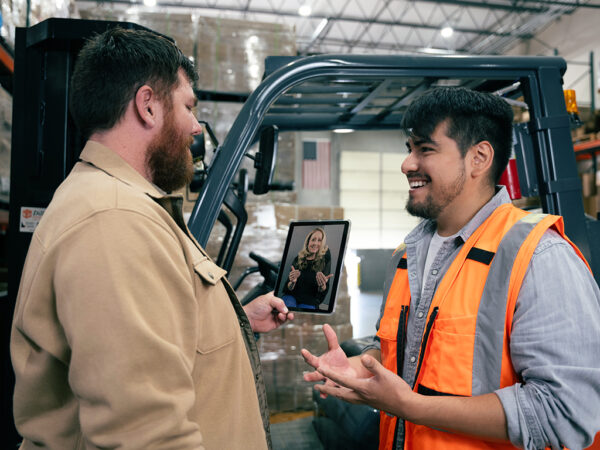
- Position the device correctly: For in-person conversations, position the screen so the Deaf or hard-of-hearing participant has a clear view. Hearing participants should stay close to the microphone or use a connected audio device.
- Make access visible: For physical locations, post signage or QR codes so users can easily access on-demand interpreting when needed.
On-demand interpreting etiquette
Even in quick conversations, ASL interpreting etiquette still applies.
- Speak directly to the Deaf or hard-of-hearing person
- Take turns and avoid overlapping speech
- Identify yourself when multiple people are present
- Allow pauses for the interpreter to finish signing, and Deaf participants to respond
- Remember that interpreters must interpret everything they hear, including side conversations
Tips for in-person conversations
- Prioritize the Deaf individual’s view of the screen
- Ask the Deaf or hard-of-hearing participant to adjust volume if needed rather than touching their device
- Move to a quieter or more private area if audio quality is an issue
Tips for virtual conversations
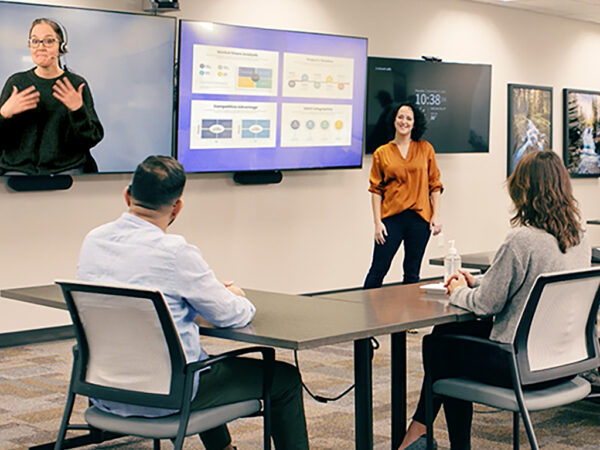
- Pin the interpreter’s video (or enable pinning) in meetings with multiple participants
- Keep cameras on so facial expressions are visible
- Pause when sharing screens or referencing visuals to confirm all can see
- Avoid repeatedly turning cameras on and off, which can cause the interpreter’s video to move
- Use the hand raise feature to signal your desire to speak and leave it up until you’re done speaking
Compare interpreting options
Not sure whether on-demand, scheduled VRI, or on-site interpreting is the best fit for your situation?
Use our interpreting solutions comparison guide to compare session length, availability, and ideal use cases across options.
Learn more about ASL interpreting etiquette
For broader guidance on working respectfully and effectively with ASL interpreters in any setting, see our full guide:
Have questions or need help choosing the right interpreting solution?
Contact us at [email protected] or visit sorenson.com
Frequently asked questions about on-demand ASL interpreting
- When should I use on-demand ASL interpreting instead of scheduled services?
On-demand video remote interpreting is best for short, spontaneous conversations that cannot be scheduled in advance. For longer or more complex discussions, scheduled VRI or on-site interpreting is recommended. - Is on-demand ASL interpreting appropriate for large meetings?
No. On-demand interpreting is designed for one-on-one or small group conversations. Large or formal meetings should use scheduled interpreting services. - Can on-demand ASL interpreting be used for virtual meetings?
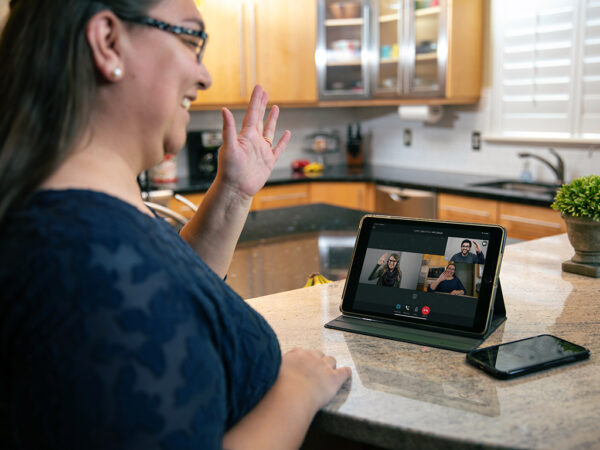
Yes. On-demand interpreting can be used within supported virtual meeting platforms for short, unplanned conversations. - Can on-demand VRI be used for in-person meetings?
Yes. VRI can support in-person meetings when participants have access to a screen, camera, microphone, and reliable internet connection. - When is Video Remote Interpreting (VRI) better than on-site interpreting?
VRI is often a better option when on-site interpreters are unavailable due to location or interpreter availability, when meetings are virtual or hybrid, or when there is a shorter turnaround time. Because VRI allows interpreters to join remotely, it can offer greater flexibility and faster access while still supporting effective communication.

