





































-
VRS

-
CaptionCall
-
Enterprise
-
Provider
-
Resources
-
Company


Sorenson Uses Cookies
Cookies are small text files websites send to your browser to remember information about your visit. They make our site work properly and help with security. When you allow cookies, you will have the best experience on our site — you can use tools such as chatbot for support and access other relevant products and services.

Best Practices for On-Site ASL Interpreting
March 16, 2026

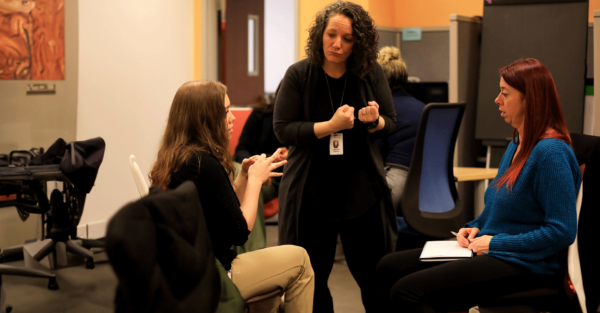
On-site ASL interpreting supports face-to-face communication during in-person meetings or events that last from a few hours to multiple days. It is especially effective when participants are moving around, when the setting is outdoors, or when reliable internet access is not available.
This guide outlines best practices for preparing for and working effectively with an on-site ASL interpreter.
When to use on-site ASL interpreting
On-site interpreting is ideal for:
- In-person meetings or events lasting several hours or multiple days
- Situations involving movement or changing locations
- Outdoor settings or locations without reliable internet access
- Conversations where relationship-building or nuance is especially important
Due to limited availability in particular locations, on-site interpreters may be harder to secure—especially on short notice. Consider Video Remote Interpreting (VRI) as an alternative.
Prepare for an on-site interpreting assignment
- Schedule as far in advance as possible: Request on-site interpreting at least 48 hours in advance whenever possible. Earlier scheduling increases the likelihood of securing preferred interpreters.
- Ask about interpreter preferences: If appropriate, ask Deaf participants whether they have preferences related to interpreter style or familiarity with certain terminology. Maintain a list of preferred interpreters familiar with your company’s language and staff name signs. If an interpreter isn’t a good fit, request that they not be assigned again.
- Share logistical and contextual details: Provide the interpreter with agendas, key names, specialized terminology, a point of contact, and relevant logistical details such as parking and building access.
- Plan for contingencies: If an on-site interpreter is not confirmed 72 hours prior to the assignment, contact the Deaf participant to discuss alternatives, such as scheduled Video Remote Interpreting (VRI), while respecting preferences for in-person services.
On-site interpreting etiquette
- Look at and speak directly to the Deaf or hard-of-hearing person
- Take turns and avoid speaking over others
- Pause to allow the interpreter to finish signing before responses
- Identify yourself when speaking in larger groups
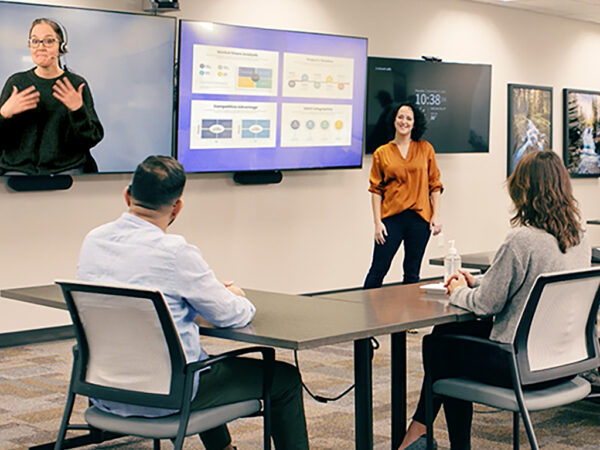
- Consult with interpreters and Deaf participants about optimal interpreter placement
- Don't block the interpreter’s visibility when presenting
- Be mindful of side conversations—interpreters are professionally obligated to interpret everything they hear.
Compare interpreting options
On-site interpreting is one of several ways to support accessible communication.
To compare on-site interpreting with scheduled Video Remote Interpreting (VRI) and on-demand ASL interpreting, review our interpreting solutions comparison guide.
Learn more about ASL interpreting etiquette
For general guidance on respectful and effective communication with ASL interpreters across all settings, see our full guide:
Have questions or need help choosing the right interpreting solution?
Contact us at [email protected] or visit sorenson.com
Frequently asked questions about on-site ASL interpreting
- How far in advance should I request an on-site ASL interpreter?
At least 48 hours in advance is recommended, though earlier requests improve availability—especially for multi-day or specialized assignments. - What happens if an on-site interpreter is unavailable?
If an on-site interpreter cannot be confirmed, scheduled Video Remote Interpreting (VRI) may be offered as an alternative, depending on the situation and participant preferences. - Is on-site interpreting required for all in-person meetings?
Not always. Many in-person meetings can be effectively supported through VRI when participants are stationary and internet access is reliable.

