










































-
VRS

-
CaptionCall
-
Enterprise
-
Provider
-
Resources
-
Company


Sorenson Uses Cookies
Cookies are small text files websites send to your browser to remember information about your visit. They make our site work properly and help with security. When you allow cookies, you will have the best experience on our site — you can use tools such as chatbot for support and access other relevant products and services.

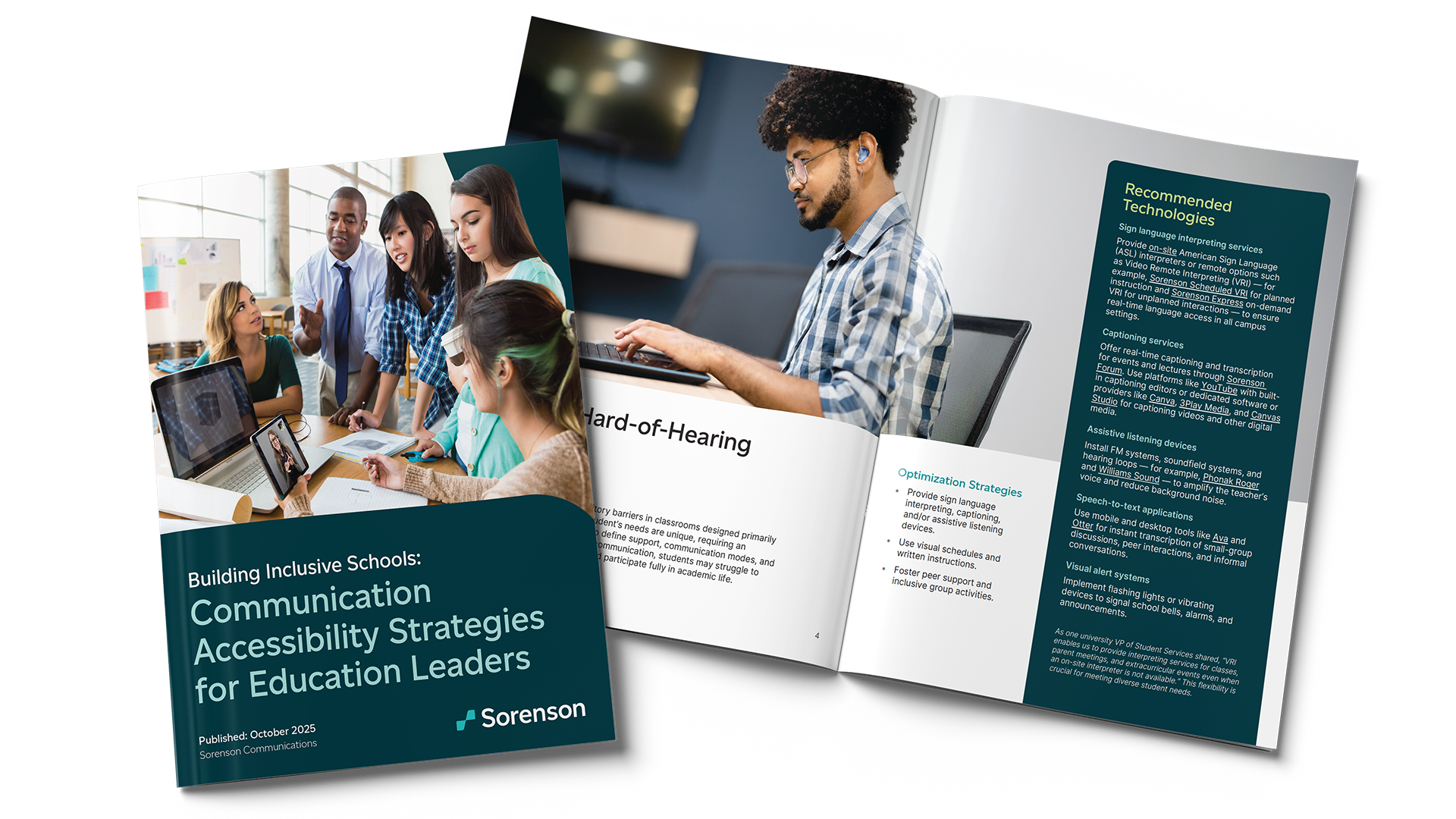
Communication Accessibility in Education: A Practical Guide for Inclusive Schools


Support Deaf, multilingual, and neurodivergent learners — while meeting ADA, IDEA, and Section 504 requirements.
Get instant access
Why communication accessibility matters
Access to information affects whether students and families can understand instruction, participate fully, and engage with educators. Providing multiple formats—spoken, written, visual, signed, and translated—is a foundational practice for inclusive education.

Who this guide is for
Leaders responsible for accessibility and student access in K–12 and higher education:
- School and district administrators
- College and university leadership teams
- ADA/504 coordinators and disability services teams
- Special education and academic support leaders

Populations covered
Includes guidance for:
- Deaf and Hard-of-Hearing students
- English Language Learners and multilingual families
- Neurodivergent learners and students with processing or sensory differences
- Nonverbal or low-vision students

What you’ll learn
- How communication barriers show up across varied student populations
- Which accessibility technologies work best for classrooms, student services, and campus-wide events
- When to use human services vs. AI-powered tools — and why both matter
- How to apply Universal Design for Learning (UDL) principles in real-world settings
- A practical roadmap for assessing, piloting, and scaling accessibility initiatives
Get instant access
Break down language barriers and build understanding at scale.
FAQs
What is communication accessibility in education?
Communication accessibility ensures that all students—Deaf, multilingual, neurodivergent, or with sensory differences—can fully access instruction, participate in activities, and engage with educators through multiple formats such as visual, signed, written, and translated content.
Why is accessibility important for schools and universities?
Accessibility helps create equitable learning environments, supports student engagement.
How can schools support Deaf and Hard-of-Hearing students?
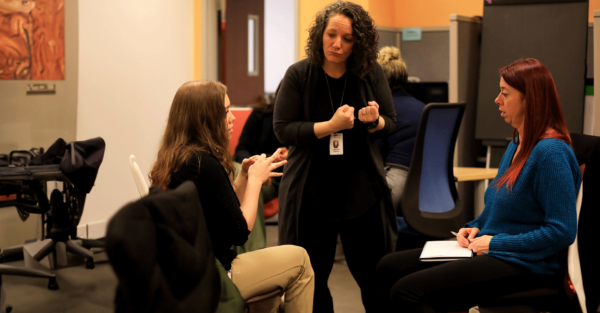
Schools can use interpreters, real-time captioning, assistive listening devices, and visual supports. The guide provides examples for classrooms, events, and family engagement.
How can schools support multilingual students and families?
Translation tools, multilingual materials, and bilingual staff can help bridge communication gaps. The guide outlines strategies for scalable and practical implementation.
Who should use this guide?
School administrators, district leaders, university leadership, ADA/504 coordinators, disability services staff, and special education leaders will find this guide most useful.
What planning steps are recommended for accessibility in education?
A 5-step approach includes assessing needs, prioritizing high-impact settings, piloting services, training staff, and continuously reviewing progress. Full checklists are included in the guide.
